

Artificial intelligence isn't coming to education. It's already here. The question isn't whether AI will impact your students' futures. It's whether they'll be ready for it.
If you're wondering what AI literacy actually means for your students, you're asking the right question at the right time.
Key Takeaways:
- AI literacy is the knowledge and skills that enable students to understand, evaluate, and responsibly use artificial intelligence systems.
- AI literacy includes three core areas:
- understanding how AI works
- evaluating AI critically
- using AI responsibly
What Is AI Literacy?
AI literacy is the knowledge and skills that enable students to understand, evaluate, and use AI systems responsibly. Think of it as an essential skill, like reading comprehension, but specifically focused on artificial intelligence.
But here's what makes AI literacy different from just "learning about technology": it's not about turning every student into a programmer or data scientist. According to educational researchers, AI literacy encompasses three interconnected areas:
- Understanding AI: Knowing what AI is, how it works at a basic level, and where it appears in daily life
- Evaluating AI: Thinking critically about AI's benefits, limitations, biases, and ethical implications
- Using AI: Applying AI tools appropriately for learning, creativity, and problem-solving
But here's what makes AI literacy different from just "learning about technology": it's not about turning every student into a programmer or data scientist.
In practical terms, an AI-literate student can explain why their Netflix recommendations work, question whether an AI-generated essay is accurate, and use AI tools ethically to enhance their learning (not replace it).
The 5 Core Components of AI Literacy
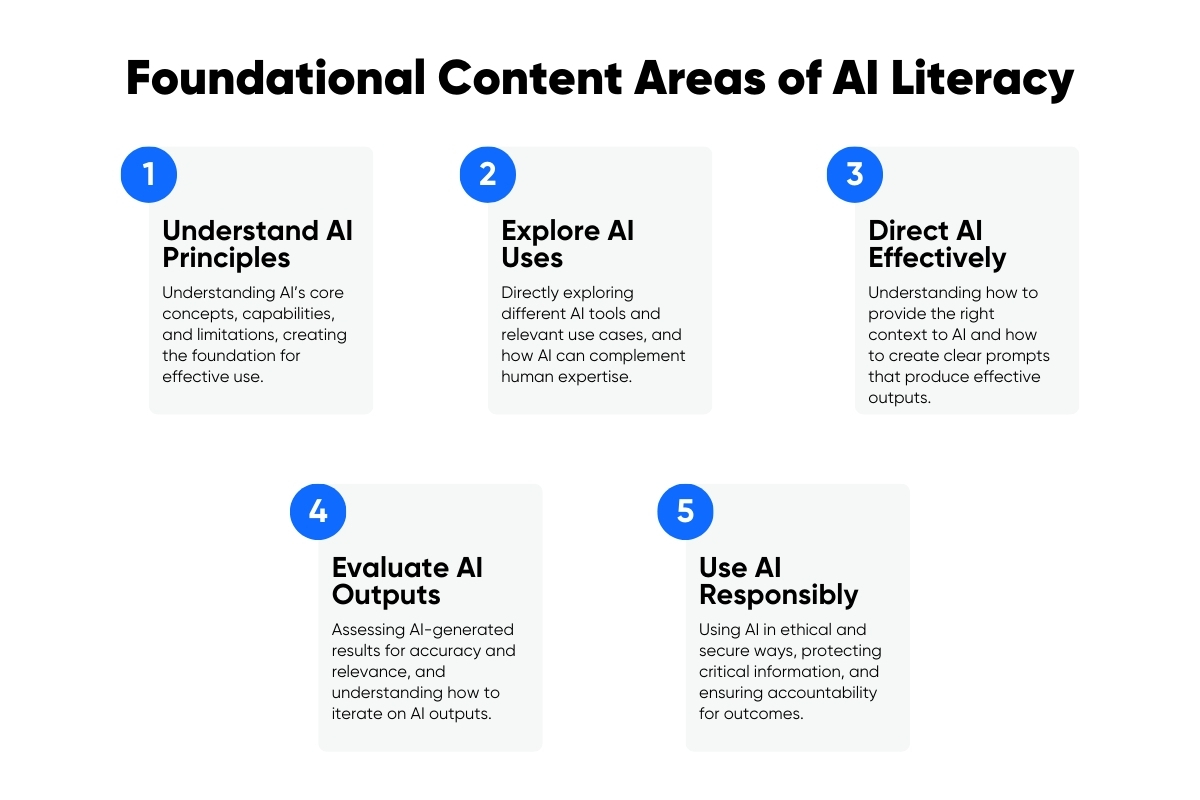
AI literacy is not a single skill. It is a set of competencies that prepare students to understand, use, evaluate, and apply artificial intelligence effectively and responsibly. Students become proficient in AI literacy when they develop strength in the following five areas.
The U.S. Department of Labor outlines five foundational components of AI literacy:
1. Understand AI Principles
Understand how AI systems work at a basic level, relying on data, recognizing patterns, and generating predictions based on probability, not truth. This helps remove any presumption of AI as illusory, or “magic.”
2. Explore AI Use Cases
Examine how AI is applied across industries and experiment with tools in structured ways. Learn where AI adds value and where human judgment remains essential.
3. Direct AI Effectively
Practice writing clear prompts, refining inputs, and improving outputs. Better instructions lead to better results.
4. Evaluate AI Outputs
Verify accuracy, identify bias, and recognize misinformation. Learn to question AI responses instead of accepting them automatically.
5. Use AI Responsibly
Understand ethical use, privacy considerations, academic integrity, and the broader societal impact of AI technologies.
Together, these five components ensure students are not passive consumers of AI, but informed and capable users.
Why AI Literacy Matters for K-12 Education
The World Economic Forum also projects that nearly 40% of workplace skills will change within five years, largely due to AI. But the impact goes far beyond future jobs.
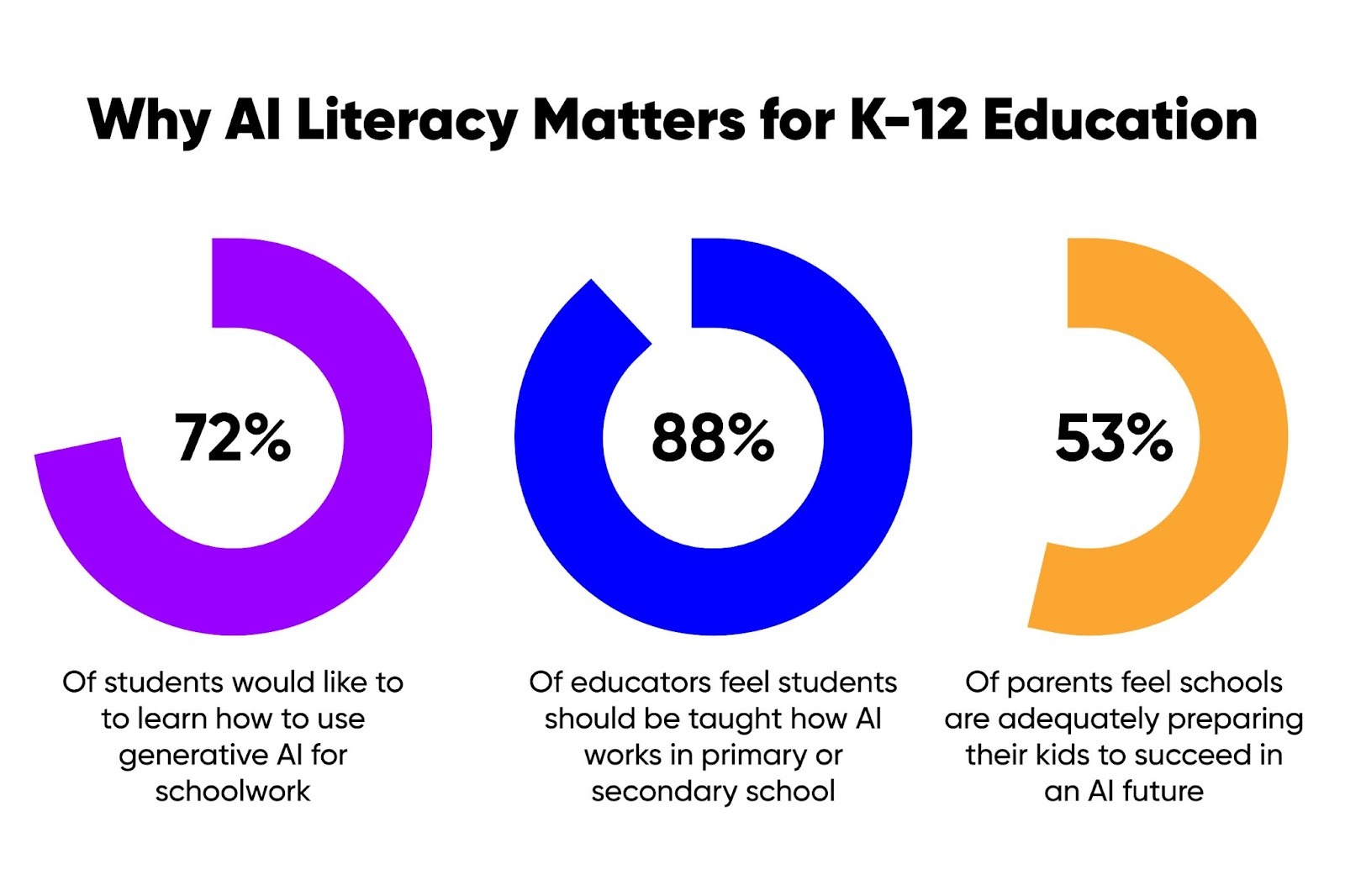
72% of students say that guidance on how to responsibly use generative AI for schoolwork would be helpful, and 88% of educators feel students should be taught how AI works in primary or secondary school. Additionally, 53% of parents feel that their schools are preparing students to succeed in an AI future. The demand for AI literacy education is clear.
AI Is Already Shaping Student Lives
Your students interact with AI dozens of times before they even get to your class. Their social media feeds, search results, autocorrect suggestions, and recommended videos are all powered by AI algorithms.
Without AI literacy, they're navigating this landscape blindly, consuming AI-generated content without the critical thinking skills to evaluate it.
Preparing Students for an AI-Powered World
Students aren't just going to use AI in their future careers. They're going to work alongside it, make decisions about it, and potentially build it.
The U.S. Department of Education emphasizes that students learn AI best through hands-on, creative engagement rather than passive consumption.
“It is imperative to address AI in education now to realize key opportunities, prevent and mitigate emergent risks, and tackle unintended consequences.”
How Computer Science and AI Literacy Work Together
Here's something many districts miss: AI literacy and computer science education aren't competing priorities. They're complementary skills that build on each other to create more capable, adaptable learners.
CS Skills Enable AI Understanding
When students learn computer science fundamentals like variables, functions, and data structures, they're building the mental models they need to truly understand how AI works. A student who understands that computers follow instructions and process data has a much easier time grasping machine learning concepts than one who sees AI as "magic."
Consider a middle schooler learning Python who writes code to sort a list of numbers.
Later, when they use AI tools that recommend videos or categorize images, they understand that AI is also sorting and organizing data, just at a much larger scale.
AI gives answers.
Computer science helps students understand how those answers were created—and whether they should trust them.
Computational Thinking Powers Critical AI Evaluation
Computer science teaches computational thinking: breaking problems into smaller parts, recognizing patterns, and creating logical solutions. These same skills are essential for evaluating AI systems critically.
Students who've debugged their own code understand that systems can have errors and biases. They're less likely to blindly trust AI outputs and more likely to ask:
- What data trained this system?
- Could the algorithm produce biased results?
- What happens when the AI encounters something unexpected?
Building Durable, Future-Ready Skills
The job market your students will enter doesn't just need programmers or AI experts. It needs people who can work alongside both technologies.
AI is the entry point.
Computer science is the foundation.
Career pathways are the outcome.
Integrated Learning Pathways
The most effective approach combines both literacies in a cohesive learning pathway. For example:
- Elementary students learn block-based coding in Launch Pad (K-5) while exploring how AI recognizes patterns in their daily lives
- Middle schoolers build text-based programs in Voyage (6-12) and critically examine real-world AI applications
- High school students create projects using HTML, CSS, JavaScript, or Python while understanding how these languages power AI-driven web applications
This integrated approach means students are developing a comprehensive understanding of how technology shapes the world and how they can shape technology.
Integrating AI Literacy Into Your Curriculum
AI literacy does not require a new standalone course. It can be integrated into existing instruction with clear structure and support.
Embed AI Literacy Across Subjects
AI literacy fits naturally into current classrooms:
- ELA: Analyze AI-generated text, discuss authorship and bias
- Social Studies: Examine data privacy, algorithms, and societal impact
- Science: Explore AI in research and real-world problem-solving
- Math: Connect AI to data, patterns, and probability
- Arts: Create with AI while evaluating originality and ethics
Start With Structured, Ready-to-Teach Lessons
One of the biggest barriers to AI literacy is time. Teachers are already balancing full plates, and building AI lessons from scratch is unrealistic.
Skill Struck’s AI literacy courses are designed with this reality in mind. The lessons are already built, sequenced, and classroom-ready. They introduce AI fundamentals in clear, student-friendly language and guide students through understanding, evaluating, and using AI responsibly.
Bring AI Literacy Curriculum to the Classroom Today
Skill Struck provides structured, classroom-ready AI literacy curriculum designed to make integration simple for schools.
Educators gain:
- Standards-aligned, ready-to-teach lessons
- Age-appropriate content across grade levels
- Built-in focus on evaluation, ethics, and responsible use
- Professional learning and ongoing support
Instead of building from scratch, districts can implement AI literacy with practical tools that fit into existing instruction.
Create your FREE AI literacy account today.

Looking for a comprehensive, standards-aligned AI literacy curriculum for the 2025-26 school year? Skill Struck is offering school districts free access to their full suite of age-appropriate AI courses. Learn more here.