

.jpg)
What Is AI and Digital Readiness? A Framework for K-12
AI & Digital Readiness is the ability to use, understand, build, and apply emerging technologies. Built on durable human skills, these abilities keep students ready for an ever-changing workforce.
When electricity slowly spread, it caused lasting changes across every industry. (I wrote about that in Part 1 of this series on AI and Digital Readiness.) It's not hard to see AI doing the same, just much faster.
So the question is: how can we help the current and incoming workforce be ready?
We'll be using the two terms "AI Readiness" and "Digital Readiness" together a lot, so here's how we are thinking about these terms for students.
What is digital readiness?
Digital readiness is a student's ability to navigate technology safely and effectively, and to create with it. It starts with digital literacy (working with digital tools, evaluating sources, protecting privacy) and grows through computer science.
What is AI readiness?
AI readiness is a student's ability to understand how AI systems produce outputs, where they fail, and when to verify, and then to apply AI tools well within a real field of work.
Put them together and you get AI & Digital Readiness: using, understanding, building, and applying technology on a foundation of durable skills.
Why AI and Digital Readiness matters right now
We don't have a crystal ball. But we can see some clear signs of what's coming.
AI, and the software and robotics that put it to work, is already changing the trajectory of careers. It's not hard to imagine some jobs at risk over the next 10+ years:
- Autonomous robots deployed in place of warehouse workers
- AI software across industries doing the tasks of entry-level workers
- Personal and commercial service robots replacing service workers
- Autonomous vehicles used in place of gig economy workers
We don't know if or when all of these changes will happen. But the landscape is shifting, and it doesn't take a data scientist to see that some of the people most affected will be low-income families and entry-level workers.
I don't share this to be doom and gloom. Simply put, we need to revisit how we help the rising generation prepare for changing workforce demands.
Where good skills meet good jobs
We're advocates of a simple Venn diagram: what is the overlap of good skills and traits with good jobs?
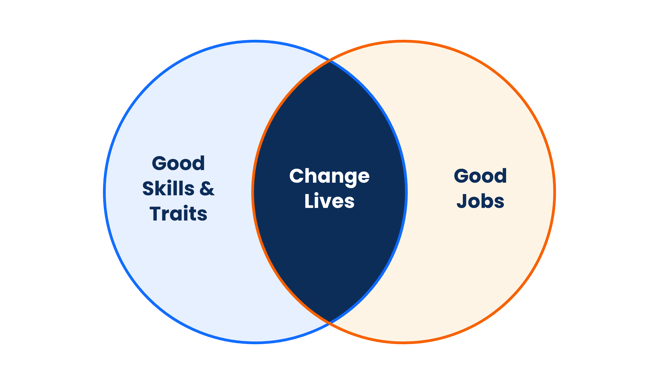
There are a lot of factors at play. But I believe the most durable protection is pretty simple: help ALL K-12 students develop traits and skills that age well, and help them love learning enough to keep adapting.
What are durable skills?
Durable skills are exactly what they sound like: the skills and traits that hold up as workforce demands change. I'm a fan of the work America Succeeds and similar organizations are doing to define them.
The research lines up. The World Economic Forum's Future of Jobs Report 2025 and the GMAC 2025 Corporate Recruiters Survey identify some of the most important skills for the next five years as:
- AI and big data
- Cybersecurity
- Technology literacy
- Creative thinking
- Problem-solving
At Skill Struck, the area we're focused on is how durable skills tie into AI & Digital Readiness.
The AI and digital readiness framework: four pillars
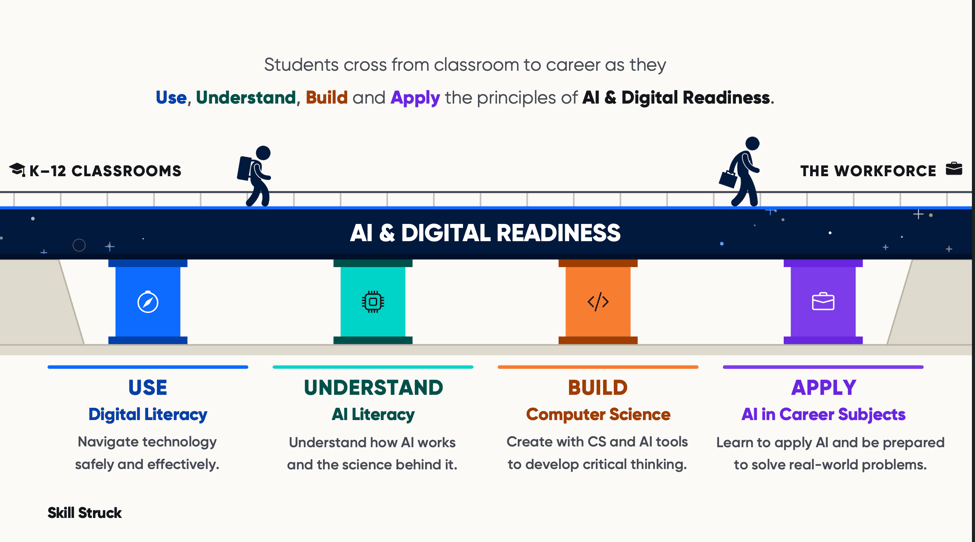
Think of it as a bridge. Students cross from the classroom to a career as they use, understand, build, and apply the principles of AI & Digital Readiness. Each pillar holds up part of the weight.
|
Pillar |
What students learn |
What it looks like |
|---|---|---|
|
Use: Digital literacy |
Navigate technology safely and effectively |
Working with digital tools, evaluating sources, protecting privacy |
|
Understand: AI literacy |
How AI works and the science behind it |
How AI systems produce outputs, where they fail, when to verify |
|
Build: Computer science |
Create with CS and AI tools to develop critical thinking |
Programming and computational thinking |
|
Apply: AI in career subjects |
Apply AI to solve real-world problems |
Using new tools within a field where the work sets the standard: cybersecurity, IT, and any CTE subject |
All four matter. A student who can only use AI tools is like the factory owner who swapped in an electric motor and changed nothing else. Students who can use, understand, build, and apply are the ones who will redesign the building.
Putting AI and digital readiness into practice
For state and district leaders, a few policy moves map directly onto the pillars:
- Use: Update digital literacy courses and standards.
- Understand: Embed AI standards into existing computer science standards, so all K-12 students get AI literacy and skills.
- Build: Require computer science standards from kindergarten through 12th grade.
- Apply: Embed AI skills into CTE pathways, or consider an Emerging Technologies Pathway.
- For every pillar: Help every current and future educator earn a micro-credential in AI.
Here's how Skill Struck supports each pillar in real classrooms:
- Use and Understand: More access to digital literacy and AI literacy curriculum, including free AI literacy for K-12 classrooms and Type Station for foundational digital skills. Plus PD, tools, and support so any educator can teach these subjects.
- Build: AI building tools in high-impact CTE areas like computer science, AI, cybersecurity, and data science.
- Apply: Micro-courses for other CTE subjects on how AI affects their industries, plus AI tools like Chat for Schools, a secure, rostered AI platform for K-12.
Why this matters beyond the job market
Work isn't the only thing that matters in life. But it does matter. Jobs provide life's necessities and shape life's options.
When we talk about employable skills, it's because we want to help break the chains of intergenerational poverty. The students most affected by changing industry demands will be those from lower socioeconomic backgrounds. It's our duty, private and public sector together, to help them.
And the durable skills students build along the way help more than employers. They help relationships, families, and communities too.
Build AI and digital readiness in your district
AI readiness and digital readiness aren't one-time checkboxes. They're a path that starts in kindergarten and ends somewhere real.
Want to see how the four pillars fit your grade bands? Get a demo and we'll walk you through it.