

What Is Digital Citizenship and Why Does It Matter?
Students today are digital natives. They have never known a world without smartphones, social media, or instant access to nearly any piece of information ever recorded.
But being comfortable with technology is not the same as knowing how to use it responsibly. Knowing how to scroll doesn't mean knowing how to think critically about what you read. Knowing how to post doesn't mean knowing how to protect your privacy.
That gap is where digital citizenship lives, and why teaching throughout students’ K-12 education matters more than ever.
According to the CDC's National Center for Health Statistics, more than half of U.S. teenagers ages 12-17 spend four or more hours on screens daily outside of schoolwork. Students are spending enormous portions of their lives in digital spaces, often without the skills or guidance they need to navigate them well. Schools have a real responsibility to close that gap.
This post covers what digital citizenship is, the key elements that make it up, why it matters in today's learning environment, and practical ways teachers and school leaders can begin building it into the classroom.
What Is Digital Citizenship?
Digital citizenship is the responsible, ethical, and safe use of technology and the internet. It's the idea that participating in digital spaces comes with the same rights and responsibilities that come with participating in any community, and that those rights and responsibilities can and should be taught.
The definition has expanded significantly over time. A decade or two ago, digital citizenship mostly meant internet safety: don't talk to strangers online, don't share your home address. Those things still matter, but the scope of what students encounter online has grown far beyond what earlier frameworks anticipated. Today, digital citizenship encompasses media literacy, digital identity, privacy, AI literacy, and much more.
One of the most important things to understand about digital citizenship is that it's not a single lesson or a once-a-year assembly. It's a mindset and a skill set that gets built gradually, across grade levels, woven into how students engage with the world. The most effective digital citizenship education isn't separate from learning. It's part of it.
Skill Struck’s digital citizenship courses are designed to help students build these skills as part of a broader K-12 computer science and technology education.
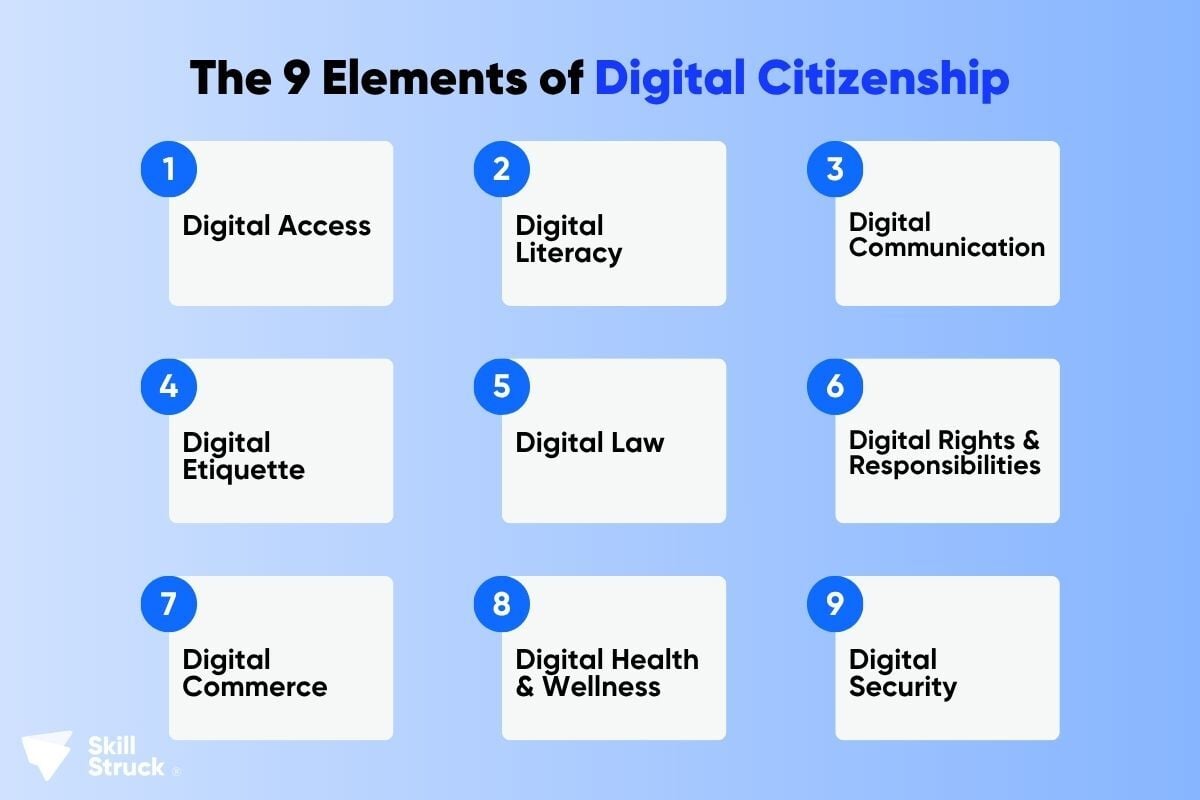
The 9 Elements of Digital Citizenship
The most widely used framework for teaching digital citizenship in K-12 schools comes from the International Society for Technology in Education (ISTE) and the foundational work of researchers Mike Ribble and Gerald Bailey. Their model breaks digital citizenship into nine interconnected elements, a framework that teachers, curriculum directors, and technology coordinators across the country rely on.
1. Digital Access
The ability to connect with others and access information using technology. This element also calls attention to equity. Not every student has the same access to devices or reliable internet, and advocating for equal digital access is part of being a responsible digital community member.
2. Digital Literacy
The ability to find, evaluate, and communicate information using digital tools. This goes beyond knowing how to use a device. It's about understanding how to assess the credibility of what you find online and how to communicate effectively across digital platforms.
3. Digital Communication
Understanding the different tools available for communicating online (email, text, social media, video) and knowing when and how to use them appropriately. Context matters: some conversations belong in certain formats, and students benefit from learning to recognize that.
4. Digital Etiquette
The standards of conduct and behavior expected in digital spaces, essentially online manners. This includes how students interact with peers, how they represent themselves online, and how they treat others in digital environments.
5. Digital Law
Understanding the legal rights and restrictions governing technology use, including copyright, plagiarism, intellectual property, and the laws around cyberbullying and harassment.
6. Digital Rights and Responsibilities
The freedoms and obligations that come with technology use. Students have rights in digital spaces, and they also have the responsibility to respect the rights of others.
7. Digital Commerce
Understanding how to safely and wisely participate in the digital economy, including making purchases, recognizing scams, and understanding data privacy in commercial contexts.
8. Digital Health and Wellness
Attending to the physical and psychological effects of technology use. This includes screen time awareness, ergonomics, and understanding the impact that social media and constant connectivity can have on mental health and well-being.
9. Digital Security
Taking steps to protect yourself and your data online: strong passwords, recognizing phishing attempts, understanding privacy settings, and knowing what information is safe (or unsafe) to share.
No teacher needs to cover all nine elements in a dedicated unit. Many of these concepts can be woven naturally into subjects students are already studying, from ELA to social studies to science. That's one of the things that makes digital citizenship both manageable and meaningful.
Why Digital Citizenship Matters More Than Ever
The case for teaching digital citizenship has never been stronger, or more urgent.
Cyberbullying is widespread and rising.
According to the Cyberbullying Research Center, approximately 55% of middle and high school students have experienced cyberbullying at some point in their lifetimes, a figure that has more than doubled since 2007. The National Center for Education Statistics reports that among students ages 12-18 who were bullied during school, 21.6% were bullied online or by text. When students understand digital etiquette, digital rights and responsibilities, and how to navigate online conflict, they're better equipped to recognize, respond to, and prevent it.
Misinformation is everywhere.
Students today are surrounded by content: videos, posts, articles, and AI-generated information that isn't always accurate or trustworthy. Teaching digital literacy means giving students the tools to evaluate what they encounter online before they share it or act on it.
AI is now part of everyday student life.
College Board research found that the majority of high school students now use generative AI tools for schoolwork. Most are doing so without much guidance. According to a report from the Center for Democracy and Technology, only 12% of students received instruction on what AI is and how it works, and only 17% were taught about its risks. Students are already using these tools. The question is whether they understand what they're doing and how to do it responsibly. Teaching digital citizenship today means teaching students how to use AI ethically, critically, and safely.
Policy is catching up, but schools can't wait.
The 2024 State of Computer Science Education report from Code.org, CSTA, and the ECEP Alliance found that while 82% of U.S. high school students now have CS classes available at their schools, only 11 states require students to earn CS credit to graduate. Digital citizenship, like CS education broadly, still reaches far too few students in a consistent, structured way. Every district that prioritizes it gives its students a real advantage.
The connection to workforce readiness matters too. Digital citizenship isn't just about keeping students safe. The skills it builds: critical thinking, ethical reasoning, responsible communication, are exactly the durable skills that employers consistently say they need from new hires. Teaching digital citizenship is preparing students for life, not just for the internet.
How to Teach Digital Citizenship by Grade Level
Digital citizenship isn't one-size-fits-all. What's appropriate and meaningful for a kindergartener is very different from what a high schooler needs. Here's a practical breakdown by grade band.
Elementary (K-5)
At the elementary level, the focus is on building foundational awareness and habits. Young students are just beginning to use technology independently, so lessons should be straightforward, concrete, and tied to their actual experience.
Key concepts at this stage include:
- What healthy screen time looks like and how to balance it
- Basic online safety: what information is private and why
- Kind and respectful communication online (digital etiquette)
- What to do if something online makes them feel uncomfortable
The goal isn't to make students afraid of technology. It's to help them approach it with awareness and confidence.
Middle School (6-8)
Middle school is often where digital citizenship becomes most urgent. Students are more independently online, more connected to social media, and more likely to encounter cyberbullying, misinformation, or peer pressure in digital spaces.
Key concepts at this stage include:
- Digital footprint and identity: what you put online can stay there, and who can see it
- Spotting misinformation and evaluating sources
- Understanding cyberbullying: what it is, how to respond, and how to be an upstander
- Intro to digital law: copyright, plagiarism, and what's actually legal online
A helpful reflection prompt for students at any age: "Would I be okay if my teacher, a parent, or a future employer saw this?" That one question can do a lot of work.
High School (9-12)
By high school, students are preparing for the workforce, higher education, and an increasingly AI-shaped world. Digital citizenship instruction at this level should be more nuanced and future-focused.
Key concepts at this stage include:
- Digital rights and responsibilities: privacy laws, data ownership, and ethics
- Security practices: protecting personal and financial information online
- Ethical AI use: understanding how AI tools work, their limitations and biases, and how to use them with integrity
- Digital commerce: navigating the online economy safely and wisely
This is also where digital citizenship connects directly to AI literacy. Students who understand how AI systems are built, how they can be biased, and how to use them appropriately are better prepared for the workforce than those who simply know how to prompt a chatbot.
Practical Ways to Integrate Digital Citizenship in Your Classroom
One of the most important insights from ISTE's digital citizenship framework is that digital citizenship can't be taught effectively as a standalone rigid course. It has to be embedded into the culture and flow of learning. The good news is that it doesn't require a complete curriculum overhaul.
A few practical ways to weave it in:
- In ELA: Have students analyze the tone and credibility of online sources. Discuss why a news article and a social media post aren't the same kind of evidence.
- In Social Studies: Explore media's role in civic life. Discuss how online spaces shape public opinion and how students can participate in civic discourse responsibly.
- In Science: Teach students how to evaluate trustworthy sources for scientific claims, a skill that transfers well beyond the classroom.
- In CS and Technology classes: Discuss data privacy, coding ethics, cybersecurity, and what it means to use AI tools responsibly. Digital citizenship fits naturally here.
You can also use real-world scenarios and role-play to make it concrete. Some teachers set up a classroom social media account and assign students rotating roles (photographer, commenter, fact-checker) to practice responsible posting and interaction together.
The key is consistency. Digital citizenship isn't a unit you finish. It's a thread that runs through the whole school year.
Skill Struck's Digital Literacy curriculum supports this kind of integrated approach, connecting foundational digital skills to the professional and civic competencies students need beyond graduation.
How Skill Struck Supports Digital Citizenship Education
At Skill Struck, digital citizenship is built into the curriculum, not bolted on as an afterthought.
Skill Struck's digital citizenship course is designed to help students learn how to keep themselves and others safe in the digital world. Students learn how to maintain a positive digital footprint, recognize online scams, communicate respectfully online, and develop the habits that make for responsible, thoughtful digital participation.
Beyond the dedicated course, digital citizenship concepts appear across Skill Struck's K-12 CS curriculum. Web Development 1 covers what it means to be a good citizen in digital communities. Fundamentals of Computer Science and Python both address digital safety and citizenship alongside core coding skills. The idea is that students encounter these concepts in context, while they're building, creating, and problem-solving, not just in the abstract.
And then there's the AI literacy layer. As AI tools become a standard part of how students learn and work, understanding how to use them ethically, critically, and safely is part of what it means to be a digital citizen. Skill Struck's free AI Literacy courses for grades K-12 are designed to meet students where they are and build that understanding from the ground up.
Help Students Become Digital Citizens in Your Classroom
Teaching digital citizenship is one of the most practical and future-focused investments a school or district can make. Students don't leave the digital world when they leave the classroom, and what they learn (or don't learn) about navigating it responsibly shapes how they show up as learners, community members, and eventually, employees.
Whether you're building a standalone digital citizenship course or looking to weave these skills into existing curriculum, Skill Struck has the tools to help. Schedule a demo to see how Skill Struck supports digital citizenship education across every grade level.