FREE K-12 AI LITERACY COURSES FOR THE 26-27 SY! Learn more here.
Download the Full '25-26 SY Impact Report

Accountability in Strengthening Communities
This is our sixth annual impact report, and it might be our most exciting yet. The purpose of this report is the same as it's always been: to show how we are making a difference in the lives of students, teachers, and communities through computer science education, artificial intelligence, and typing, and to hold ourselves accountable to the mission that drives everything we do.
This year, students across the country showed up, logged in, and did something remarkable. They coded, typed, experimented with AI, earned certifications, and proved that when you give kids the right tools and great teachers to guide them, there's no ceiling on what they can learn.
Here's a look at what we accomplished together in 2025–2026.
— The Skill Struck Team
Student and Teacher Engagement
Computer Science, AI, and Typing
During the 2025-2026 school year, students across the United States logged in and got to work. Together, they wrote 64,777,267 lines of code, a 266.1% jump over last year and proof of just how much building and experimenting happened in classrooms this year. They completed over 2.2 million typing lessons, working toward the kind of digital fluency they'll carry into any career. They pushed through 1.7 million lessons and 862,834 coding challenges, a 98.8% and 20.2% increase respectively. Students also tested their understanding through more than 2 million quizzes, up 172.7% from the year before.
On the AI side, students sent 1,246,692 prompts, a 24.7% increase, exploring everything from debugging help to creative projects. Teachers got in on it too, building 2,896 custom AI tutors shaped around their own classrooms, a brand-new milestone for Skill Struck this year.
All of this added up across 261,887 students and 9,597 educators who logged in and made it happen, an 8.2% and 1.6% increase in each group over the year before.
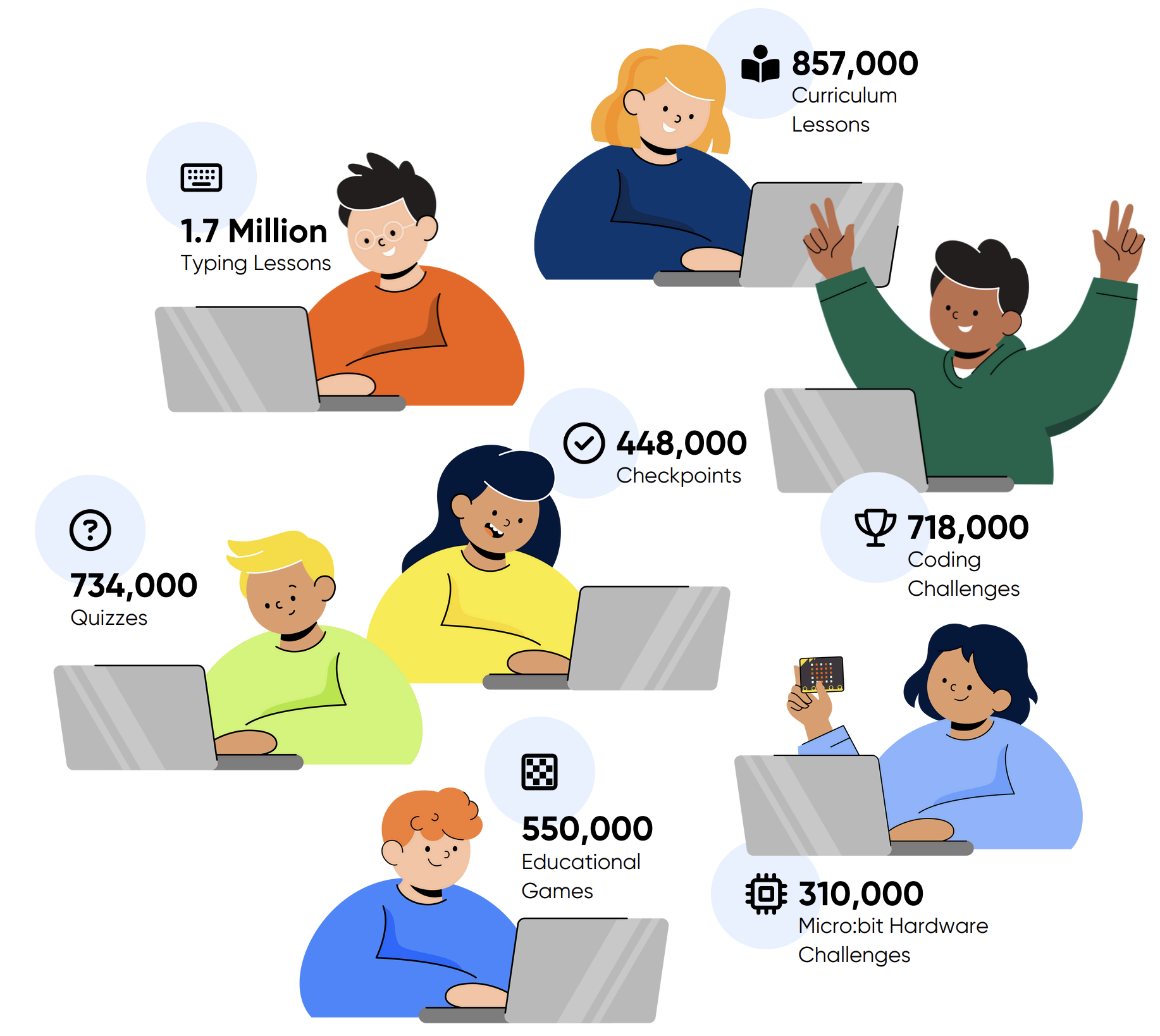
A Year of Growth
Over 64 million lines of code written by students this year.
Behind every line is a student who debugged an error, rethought an approach, or figured something out on their own. And the 2,896 custom AI tutors built by teachers show how quickly our educators have learned to make AI work for their classrooms.
The biggest movers, year over year, measured against the 2024–2025 school year, include:
- +266.1% — lines of code written by students
- +172.7% — quizzes completed
- +98.8% — lessons completed
Growth like this shows the thousands of teachers deciding, week after week, to give students a chance to build something bigger.

"I created a tutor named Rita Goodbook. She recommends books to students based on their reading level and interests. I'm working with our librarian to get our entire catalog listed with Rita. Students have told me that Rita has already helped them find a just right book!"
Ben Scoville
ELA Teacher
Murray City School District
Ben Scoville
ELA Teacher
Murray City School District
Student Outcomes & Industry Certifications
Skill Struck currently offers certification preparation courses for industry exams, directly preparing students to pass these challenging tests.
Responding to growing demand for career-ready cybersecurity skills, we added two new certification prep courses this year:
- Cisco CST Cybersecurity (New)
- CompTIA Security+ (New)
These join our existing suite of certification prep offerings, which now includes:
The Full Prep Suite
- Knowledge Pillars Java Coding Apprentice Prep
- Java Foundations from Oracle University
- Python Coding Apprentice (PCA) — Knowledge Pillars
- Python Coding Specialist (PCS) — Knowledge Pillars
- Information Technology Specialist (ITS) Python — Certiport
- Certified Entry-Level Python Programmer (PCEP) — Python Institute
- HTML & CSS Coding Specialist — Knowledge Pillars
- Cisco CST Cybersecurity
- CompTIA Security+
Students graduating with industry certifications leave high school with more than a diploma — they leave with credentials employers recognize on day one..jpg?width=6011&height=4158&name=2025-2026%20Impact%20Report%20Graphics%20(1).jpg)
Product Updates
Introducing Orbit: The Browser-Based IDE for Education
This year, we launched Orbit, a browser-based coding environment built specifically for secondary classrooms. Orbit gives teachers everything they need to assign, review, and understand student coding work — all in one place.
What makes Orbit different:
-
Version history — See exactly how a student's code evolved, and spot when large chunks appeared all at once.
-
Real-time group projects — Students collaborate like they're in Google Docs, with Orbit's version history tracking each contributor's work.
-
Canvas integration — Grades submitted in Orbit automatically pass back to Canvas. No double entry.
-
Multi-language support — Python, Java, C++, HTML, CSS, and JavaScript.
-
Sandbox environment — Students can build personal projects outside of assignments, with everything autosaved.
Orbit is designed to complement Voyage, giving teachers more flexibility to expand and customize learning beyond structured curriculum. For schools already on Skill Struck, getting students into Orbit is seamless.
The Rest of the Product Year
These are the upgrades teachers asked for and got.
Smart Activities
Engaging, game-based experiences embedded directly into lessons, so practice happens inside the lesson instead of alongside it. Part of a wave of upgrades for next year that also includes a refreshed K–2 design, richer lesson presentations and videos, and PDF uploads in teacher chats.
Ace Debugging Tool
Students find and fix errors faster with built-in debugging support — one of the most critical real-world coding skills, from day one.
Required Launch Pad Activities
Teachers can require specific Launch Pad activities, so no one skips the foundational skills.
Code View in Launch Pad
Full visibility into student code submissions, right inside Launch Pad. No more guessing who's doing the work.
Cross-Curricular Courses
Science with the micro:bit and ELA with Blocks bring computational thinking into classrooms beyond CS.
Media Bank + File Pathways
A growing library of media assets, and students can reference files inside their own projects.
AI Quiz Insights
AI-powered insights in Student Progress surface exactly where students are struggling, so teachers can act fast.
Required Quiz Scores
Teachers can set minimum passing scores in Voyage, creating clear expectations and built-in accountability.
SOC 2 Type 2 Compliance
Skill Struck meets the gold standard for data security. Districts can trust that student data is protected at every level.
Curriculum Updates
State-Specific Courses
This year we also introduced state-specific courses tailored to local standards and CTE pathways.
22 new courses across 8 states
-
North Carolina — 6 courses: CS Discoveries 1 · 2 · 3 · Computer Science 1 · 2 · Intro to Computer Science
-
Idaho — 4 courses: Digital Literacy · Computer Science Grades 6-8 · Computer Science Grades 9-12 · Programming and Software Development
-
Indiana — 4 courses: Computing Foundations for a Digital Age · Introduction to Computer Science and Digital Technology · Principles of Computing · Computer Science Grades 6-8
-
Alabama — 3 courses: Computer Science Grade 6 · Grade 7 · Grade 8
-
Louisiana — 2 courses: Computer Science Grades 6-8 · Computer Science
-
California — 1 course: Computer Science Grades 9-12
-
Tennessee — 1 course: Computer Science
-
Virginia — 1 course: Computer Science Grades 6-8
11 New AI Literacy Micro-Courses
This year we released 11 new AI literacy micro-courses, expanding our free AI literacy offering for the 2025–2026 school year. These short, focused courses are designed to be accessible to any student — no prior CS experience required — and cover the foundational concepts students need to understand, use, and think critically about artificial intelligence.
As AI continues to shape every industry and aspect of daily life, we believe every student deserves to understand it — not just the ones in advanced CS classes. That's why these courses are free.
-
The Art of Prompt Engineering
-
Sustainability in Tech
-
The Ethics & Art of AI
-
AI in Cybersecurity
-
Human-Machine Collaboration
-
AI in Sound & Music
-
Global AI Policy
-
AI for Environmental Monitoring
-
How Machines Mimic Minds
-
AI for Social Impact
-
Emotions in AI
5 lessons per course · self-paced · free in Voyage
And an 18-lesson AI Literacy Professional Development (PD) course for teachers "Voyage AI Literacy PD for Teachers" helps educators understand AI and lead classroom conversations with confidence. The micro-courses can be assigned as teacher PD too.
Educator of the '25-26 SY: Latasha Moore
This year, we are proud to recognize Latasha Moore as the Skill Struck Educator of the 2025-2026 School Year.
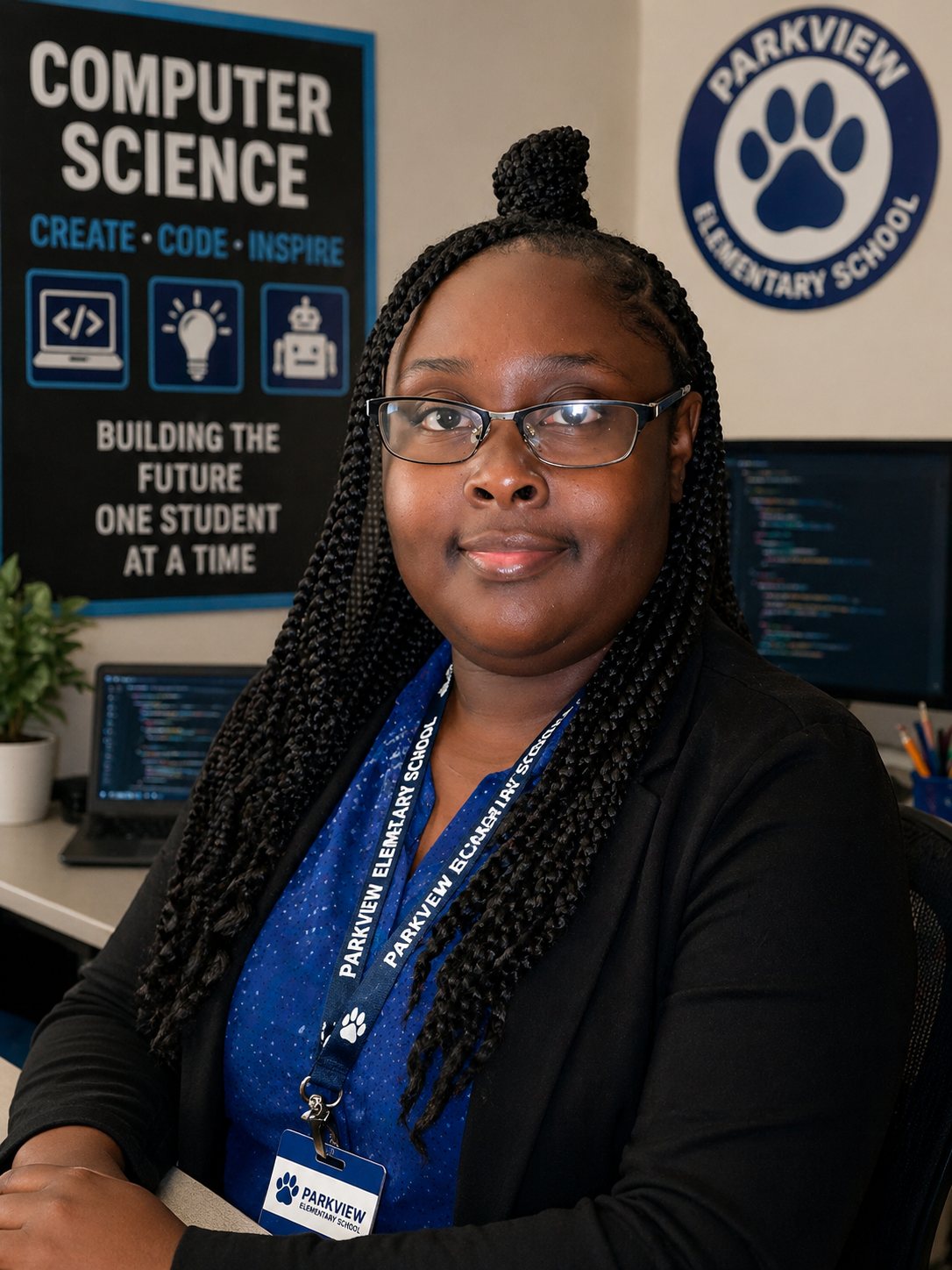
"One of the most important lessons I teach my students is to never say 'can't.' I say this because when my principal first asked me to teach Computer Science, my immediate response was that I couldn't do it. I doubted myself. Now, three years later, I'm proud of how far I've come — and I believe I've done a good job."
Latasha Moore
Computer Science Teacher
Parkview Elementary School
Latasha Moore
Computer Science Teacher
Parkview Elementary School
Looking Forward: A Letter from the CEO
The question I hear most often from parents and superintendents is some version of this: will AI make my students dumber?
It is a fair question. Mark Guzdial, a computing education researcher at Michigan, gave us a useful way to frame it. Apple used to sell the computer as "a bicycle for the mind." Guzdial argues that generative AI behaves more like an automobile. A bicycle extends what you can do and still uses your legs to do it. An automobile gets you to the same place while you sit still.
When machines took over the physical work in the 1800s, schools eventually put physical education into the day. Machines are starting to do the thinking work now.
Computer science is one of the closest things we have to exercise for the brain.
That is what the numbers in this report represent to me. Behind a large share of those 64 million lines of code is a student who ran something, watched it break, and went looking for the reason.
Seymour Papert taught kids that response in 1980. Look at work that does not run and find the one thing wrong, rather than deciding the whole thing is wrong and starting over. Our students will spend their working lives receiving confident, fluent, occasionally wrong answers from machines. Debugging is the skill that lets them tell the difference.
This year we started using a phrase you will hear more from us: AI and Digital Readiness. Students need to use digital tools well, understand how AI systems work and where they fail, build through programming and computational thinking, and apply these tools inside a career field. Four abilities, resting on durable human skills.

Thank you to the many educators who made this school year happen. We are eager to see the impact for the '26–27 school year!
Parker Gentry
CEO
Skill Struck
Parker Gentry
CEO
Skill Struck