FREE K-12 AI LITERACY COURSES FOR THE 26-27 SY! Learn more here.

Computer Science Basics
This course introduces students to the basics of computer science. Students will discover the fundamentals of various computer science topics from the internet, to cybersecurity, to ethics of technology.
- JavaScript
- Block Coding
- Voyage
- Unit
- 6th grade
- 7th grade
- 8th grade
- 9th grade
- 10th grade
- 11th grade
- 12th grade
Course Summary
This course introduces students to the basics of computer science. They explore concepts such as binary, computer parts and pieces, the internet, cybersecurity, the Digital Divide, history of computer science, and careers in tech. Students will study these topics and answer questions to apply their understanding.
Course Outline
-
- Binary Learn the basics of binary--why it exists and how the computer uses it to communicate information.
- Representing Numbers with Binary Learn how to convert information into binary and back.
- Bits and Bytes Learn what bits are and how they relate to binary!
- Representing Text with Binary Learn how we use binary code to represent letters.
- Representing Images with Binary Learn how to use binary to represent images
-
- Computer Parts and Pieces Learn the different parts that make up a computer!
- From Electricity to a Bit Learn how information moves through computer components to generate the programs you enjoy.
- Troubleshooting Learn some strategies for fixing computer problems.
- Types of Software
-
- Intro to the Internet Learn what a network is and what parts of our lives interact with networks.
- Packets and Protocols Learn how data is transferred across the internet.
- Impacts of the Internet Learn how the internet has impacted society and the world as we know it.
- Network Parts and Pieces Learn about the different parts that help make the internet run!
- Addressing Learn how addressing works in the internet.
- Network Topologies Learn how different layouts of networks can help information move more efficiently
- Search Engines Learn about how search engines can help you and discover different kinds of search engines.
-
- Passwords Learn how to make a strong password.
- Types of Threat Learn about the different approaches criminals might take cause problems.
- Legal and Ethical Concerns in Innovations Learn about legal and ethical concerns surrounding computing innovations.
- Copyright Learn about the different laws surrounding creative works.
- Cyber Bullying
- Personal Data
- Cybersecurity Posture Learn about different ways you can stay safe while using the internet.
- Rogue Access Points Learn what access points are and explore how someone might exploit them.
- Encryption Learn how encryption helps make things more secure.
- Computer Viruses Learn more about computer viruses and how they operate.
-
- Programming Languages
- Error Messages & Debugging
- Digital Citizenship Learn about digital citizenship and how you can be responsible with your technology.
- The Digital Divide
- Accessibility Learn about how we can make computer programs more accessible.
- Outside Libraries Learn how outside libraries can make building projects much easier!
- Data
- Simulations
- Computer Innovations Explore how different computer innovations have affected our everyday lives.
- AI, Machine Learning, & Automation Learn how artificial intelligence, machine learning, and automation are affecting your world and potential changes in the future.
- Data Structures Learn about the different ways we use data and the challenges associated with data collection, structure, and interpretation.
-
- Introduction to Algorithms Learn what an algorithm is and where they are in your life.
- Visualizing Algorithms Learn how to create flow charts to visualize your algorithms.
- Algorithms in Computer Programming Practice building algorithms for computer programming!
- Events in Programming Learn how events can help you make more specific programs!
- Variables in Programming Learn the basics behind variables and how they are used in programming.
- Conditionals in Programming Learn how conditionals can help make choices in your programs!
- Loops in Programming Did you know that programming can have loops just like a roller coaster? Learn how to use a loop in this lesson.
-
- Team Members in Tech
- Software Engineer Learn what it means to be a software engineer!
- Computer Systems Manager Learn what it means to be a computer systems manager!
- Database Administrator Learn what it means to be a database administrator!
- Network Analyst Learn what it means to be a network analyst!
- Video Game Developer Learn what it means to be a video game developer!
- Bioinformatic Scientist Learn what it means to be a bioinformatic scientist
- Drone Software Engineer Learn what it means to be a drone software engineer!
- Computer Science Teacher Learn what it means to be a computer science teacher!
- Virtual Reality Specialist Learn what it means to be a virtual reality specialist!
- Hardware Engineer Learn what it means to be a hardware engineer!
- Web Developer Learn what it means to be a web developer!
- Information Security Analyst Learn what it means to be an information security analyst!
- Health Information Technician Learn what it means to be a health information technician!
- Data Scientist Learn what it means to be a data scientist!
- Software Tester Learn what it means to be a software tester!
- App Developer Learn what it means to be an app developer!
- Artificial Intelligence Specialist Learn what it means to be an Artificial Intelligence Specialist!
- Ethical Hacker Learn what it means to be an ethical hacker!
- Web Designer Learn what it means to be a web designer!
- Agricultural Engineer Learn what it means to be an agricultural engineer!
- Marine Scientist
- Food Scientist
- Ecologist Learn what it's like to be a ecologist!
- Climatologist
- Biometrician
- Remote Sensing Specialist
-
- Computer Innovations Explore how different computer innovations have affected our everyday lives.
- History of Computer Science Timeline Learn about the history of computer science and see how far we have come!
Standard Alignment
State standards documents
| Document | Standards | Grades |
|---|---|---|
| National | ||
| 2022 Skill Struck Standards Alignment + Correlation Guide | CSTA K-12 Computer Science Standards · 2022 | K-2, 3-5, 6-8, 9-12 |
| Alabama | ||
| Alabama Course of Study Digital Literacy and CS Standards + Skill Struck Alignment | Alabama Course of Study Digital Literacy and CS Standards | K-2, 3-5, 6-8, 9-12 |
| Arizona | ||
| Arizona Computer Science Standards + Skill Struck Alignment | Arizona Computer Science Standards | K-2, 3-5, 6-8, 9-12 |
| Arkansas | ||
| Arkansas Computer Science and Computing Standards High School Programming + Skill Struck Alignment | Arkansas Computer Science and Computing Standards High School Programming · 2023 | 9-12 |
| Arkansas Computer Science and Computing Standards Middle School Introduction to Coding Standards + Skill Struck Alignment | Arkansas Computer Science and Computing Standards Middle School Introduction to Coding Standards · 2023 | 6-8 |
| California | ||
| California K-12 CS Standards + Skill Struck Alignment | California K-12 CS Standards | K-2, 3-5, 6-8, 9-12 |
| Georgia | ||
| Georgia Standards of Excellence for K-8 Computer Science + Skill Struck Alignment | Georgia Standards of Excellence for K-8 Computer Science | K-2, 3-5, 6-8 |
| Idaho | ||
| Idaho Content Standards Computer Science + Skill Struck Alignment | Idaho Content Standards Computer Science · 2023 | K-2, 3-5, 6-8, 9-12 |
| Illinois | ||
| Illinois Computer Science Standards + Skill Struck Alignment | Illinois Computer Science Standards · 2022 | K-2, 3-5, 6-8, 9-12 |
| Indiana | ||
| Indiana K-12 Computer Science Standards + Skill Struck Alignment | Indiana K-12 Computer Science Standards · 2023 | K-2, 3-5, 6-8, 9-12 |
| Iowa | ||
| Iowa Computer Science Standards + Skill Struck Alignment | Iowa Computer Science Standards | K-2, 3-5, 6-8, 9-12 |
| Kansas | ||
| Kansas CS Standards P-12 + Skill Struck Alignment | Kansas CS Standards P-12 · 2023 | K-2, 3-5, 6-8, 9-12 |
| Kentucky | ||
| Kentucky Academic Standards for Computer Science + Skill Struck Alignment | Kentucky Academic Standards for Computer Science · 2023 | K-2, 3-5, 6-8, 9-12 |
| Maryland | ||
| Maryland K-12 CS Standards + Skill Struck Alignment | Maryland K-12 CS Standards · 2023 | K-2, 3-5, 6-8, 9-12 |
| Massachusetts | ||
| Massachusetts Digital Literacy and Computer Science Standards + Skill Struck Alignment | Massachusetts Digital Literacy and Computer Science Standards · 2023 | K-2, 3-5, 6-8, 9-12 |
| Michigan | ||
| Michigan K-12 Standards Computer Science + Skill Struck Alignment | Michigan K-12 Standards Computer Science · 2023 | K-2, 3-5, 6-8, 9-12 |
| Mississippi | ||
| Mississippi College and Career Readiness standards for Computer Science + Skill Struck Alignment | Mississippi College and Career Readiness standards for Computer Science · 2022 | K-2, 3-5, 6-8, 9-12 |
| Missouri | ||
| Missouri K-12 Computer Science Performance Standards + Skill Struck Alignment | Missouri K-12 Computer Science Performance Standards · 2023 | K-2, 3-5, 6-8, 9-12 |
| Nebraska | ||
| Nebraska K-12 Technology Standards + Skill Struck Alignment | Nebraska K-12 Technology Standards · 2023 | K-2, 3-5, 6-8, 9-12 |
| Nevada | ||
| Nevada Academic Content Standards for CS + Skill Struck Alignment | Nevada Academic Content Standards for CS | K-2, 3-5, 6-8, 9-12 |
| Nevada Academic Content Standards for Integrated Technology + Skill Struck Alignment | Nevada Academic Content Standards for Integrated Technology | K-2, 3-5, 6-8, 9-12 |
| Nevada Computer Science Standards + Skill Struck Alignment | Nevada Computer Science Standards | 9-12 |
| New Jersey | ||
| New Jersey Computer Science and Design Thinking Standards + Skill Struck Alignment | New Jersey Computer Science and Design Thinking Standards · 2020 | K-2, 3-5, 6-8, 9-12 |
| New York | ||
| New York Computer Science and Digital Fluency Learning Standards K-12 + Skill Struck Alignment | New York Computer Science and Digital Fluency Learning Standards K-12 | K-2, 3-5, 6-8, 9-12 |
| North Carolina | ||
| North Carolina K-12 CS Standards + Skill Struck Alignment | North Carolina K-12 CS Standards | K-2, 3-5, 6-8, 9-12 |
| Ohio | ||
| Ohio's Learning Standards Computer Science + Skill Struck Alignment | Ohio's Learning Standards Computer Science · 2023 | K-2, 3-5, 6-8, 9-12 |
| Oklahoma | ||
| Oklahoma Academic Standards for Computer Science + Skill Struck Alignment | Oklahoma Academic Standards for Computer Science | K-2, 3-5, 6-8, 9-12 |
| Rhode Island | ||
| Rhode Island's K-12 CS Education Standards + Skill Struck Alignment | Rhode Island's K-12 CS Education Standards | K-2, 3-5, 6-8, 9-12 |
| South Carolina | ||
| South Carolina Computer Science and Digital Literacy Standards + Skill Struck Alignment | South Carolina Computer Science and Digital Literacy Standards · 2023 | K-2, 3-5, 6-8 |
| South Carolina's Computer Science Standards for High School + Skill Struck Alignment | South Carolina's Computer Science Standards for High School · 2023 | 9-12 |
| Tennessee | ||
| Tennessee K-12 Computer Science State Standards + Skill Struck Alignment | Tennessee K-12 Computer Science State Standards · 2023 | K-2, 3-5, 6-8, 9-12 |
| Texas | ||
| TEKs Skills for CTE + Skill Struck Alignment | TEKs Skills for CTE | 9-12 |
| TEKs Technology Applications K-8 Standards + Skill Struck Alignment | TEKs Technology Applications K-8 Standards | K-2, 3-5, 6-8 |
| Utah | ||
| Utah 6-12 CS Standards + Skill Struck Alignment | Utah 6-12 CS Standards · 2019 | 6-8, 9-12 |
| Virginia | ||
| Virginia K-12 CS Standards + Skill Struck Alignment | Virginia K-12 CS Standards · 2023 | K-2, 3-5, 6-8, 9-12 |
| Washington | ||
| Washington K-12 CS State Learning Standards + Skill Struck Alignment | Washington K-12 CS State Learning Standards | K-2, 3-5, 6-8, 9-12 |
| Wisconsin | ||
| Wisconsin Standards for Computer Science + Skill Struck Alignment | Wisconsin Standards for Computer Science · 2023 | K-2, 3-5, 6-8, 9-12 |
| Wyoming | ||
| Wyoming Computer Science Content Standards + Skill Struck Alignment | Wyoming Computer Science Content Standards · 2020 | K-2, 3-5, 6-8 |
Course Project
In this course students will complete challenges that help solidify concepts as they use skills in a variety of ways. In order to complete tasks, students will creatively apply what they've learned by using different approaches to reach a goal. This experience closely follows challenges they would face in a technical interview, allowing them to practice. Some examples of projects: Find the Tens Place, Remove String Section, Leap Year, Factorial, Halloween Candy Count
-
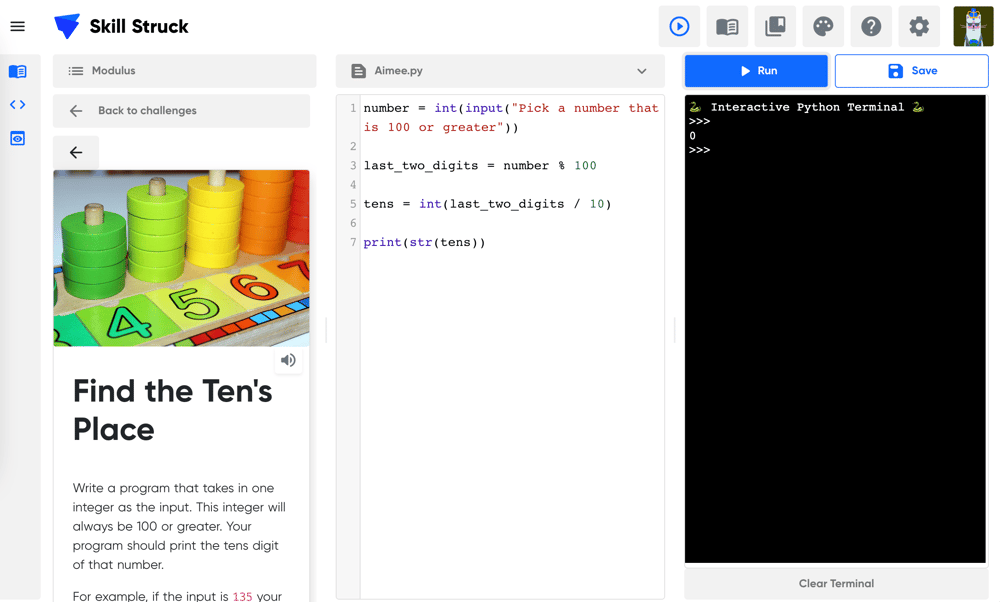
Find the Tens Place -
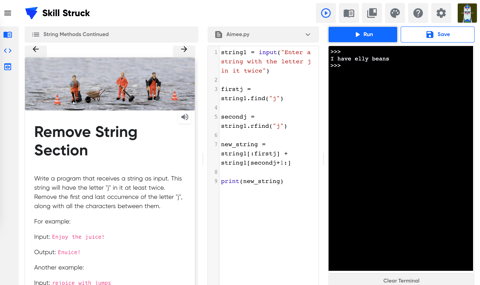
Remove String Section -
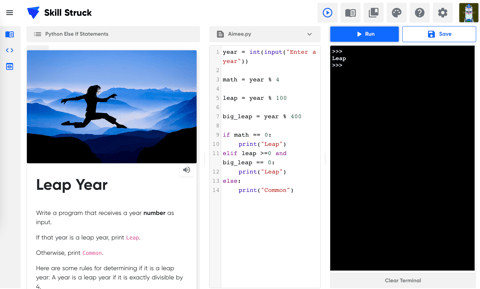
Leap Year -
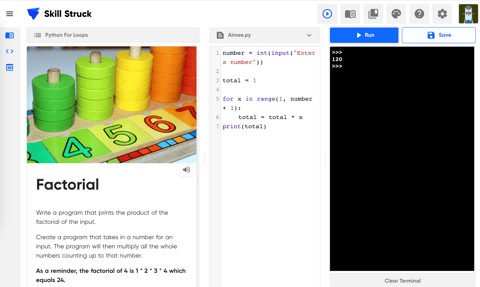
Factorial -
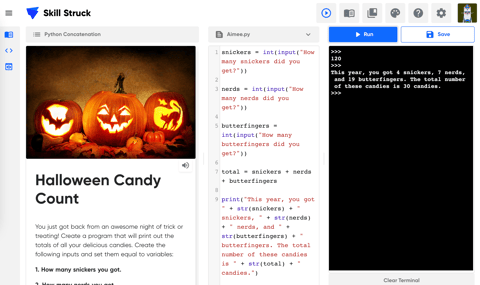
Halloween Candy Count


