FREE K-12 AI LITERACY COURSES FOR THE 26-27 SY! Learn more here.

Game Design with Python
This course walks students through basic Python concepts within the context of game design. Students will also explore other topics such as the internet, digital citizenship, and data.
- Python
- Voyage
- Semester
- 6th grade
- 7th grade
- 8th grade
- 9th grade
- 10th grade
- 11th grade
- 12th grade
Course Summary
This course includes coding exercises and practice on the Skill Struck platform as well as collaborative classroom activities, discussion points, supplemental material, and unplugged activities. Students learn the basics of Python and implement the concepts they learn by creating drawings, animations, and computer games. Students complete both a team and independent project to demonstrate their game design and Python skills. Along with these programming concepts, students will learn about digital safety, digital citizenship, computers, the internet, and more.
Course Outline
-
- Introduction to Python in Game Design Welcome to Python! This lesson gives a great introduction to Python programming and will get you up and coding in no time.
- Variables in Game Design Variables are an important part of programming. Let's find out how we can use them in this lesson.
- Input/Output in Game Design Games rely on input from the user to play the game. Learn how to take in an input and use it in your program!
- Intro to the Internet Learn what a network is and what parts of our lives interact with networks.
- Network Topologies Learn how different layouts of networks can help information move more efficiently
- Addressing Learn how addressing works in the internet.
- Syntax & Comments for Game Design This lesson covers basic Python syntax and how to add comments to your code.
- Variable Types in Game Design There are lots of different ways that you can store data in Python. This lesson covers a few of those data types.
- Python Concatenation Connecting strings together can be very useful. Let's take a look at how this can be accomplished.
- Math in Game Design Learn how to use math with Python.
- Lists in Game Design Lists are one of the main ways that we organize data in most programming languages. This lesson covers how to use lists in Python.
- If Statements in Game Design If statements allow you to decide what code should run depending on some conditions. This lesson will cover the basics on using if statements in Python.
- Conditionals in Game Design This lesson covers conditionals and how you can use them to compare data. We will also use if statements to execute code based on the conditionals.
- Else If Statements in Game Design Else If statements in Python allow you to add multiple if statements at once. The possibilities are endless!
- Functions in Game Design Functions are a great way to break up long sections of code and can be used multiple times without having to rewrite them.
- Types of Threat Learn about the different approaches criminals might take cause problems.
- While Loops in Game Design
- Programming Languages Learn about different programming languages, how they are used, and what they are used to build.
- Function Parameters in Game Design One of the great things about functions is that we can pass parameters to them and the function can handle the rest.
-
- Python For Loops This lesson covers For Loops and how to use them in Python. You will also learn how to access each item in a list using a For Loop.
- Binary Learn the basics of binary--why it exists and how the computer uses it to communicate information.
- Representing Text with Binary Learn how we use binary to represent text.
- Representing Images with Binary Learn how to use binary to represent images
- Copyright Learn what we can and cannot use on the internet and why.
- Pygame Basics Learn how to initialize a Pygame environment!
- Accessibility Learn about how we can make computer programs more accessible.
- Background for Drawing Shapes in Pygame Learn how to use Pygame to draw shapes that you would use in your games!
- Draw a Circle Learn more about how to draw a circle in Pygame!
- Data Compression Overview Learn what data compression is and how it is used.
- Lossless Text Compression Learn how we can compress text files in a way that they can be perfectly recreated.
- Draw a Rectangle Learn how to draw a rectangle in Pygame!
- Draw a Triangle Learn how to draw a triangle in Pygame!
- Draw a Straight Line Learn to draw a straight line in Pygame!
- Bigger Bytes Learn about the different sizes of data.
- Draw an Arc Learn how to draw an arc in Pygame!
- Data Learn how computers help us understand data sets.
- Draw a Smiley Face Practice drawing all the shapes you've learned so far in Pygame!
-
- Types of Computer Games Learn the basic types and categories of video games and discover examples of each.
- AI, Machine Learning, & Automation Learn how artificial intelligence, machine learning, and automation are affecting your world and potential changes in the future.
- Algorithms Discuss what an algorithm is and how they are used in creating video games.
- Random in Game Design Learn how to use random in generating games.
- The Digital Divide Learn what the Digital Divide is and how it affects people in different situations.
- Text on the Screen Learn how to add words to your screen!
- Timer Counting Up Learn how to create a timer for your games!
- Encryption Learn how encryption helps make things more secure.
- Timer Counting Down Learn how to add a countdown timer in Pygame!
- Rogue Access Points Learn what access points are and explore how someone might exploit them.
- Types of Threat Learn about the different approaches criminals might take cause problems.
- Animate Drawings Learn how to animate your drawings on Pygame.
- Computer Innovations Explore how different computer innovations have affected our everyday lives.
- Legal and Ethical Concerns in Innovations Learn about legal and ethical concerns surrounding computing innovations.
- Personal Data Learn how your personal data is available and could be without you knowing it!
- Bounce Your Drawings Learn how to bounce your drawings off the walls
- Move Drawing with Keyboard Learn how to move your drawing around the page with your keyboard.
- Move a Drawing with Mouse Learn how to move drawings around the screen with the mouse!
- Clicking the Mouse Event Learn how to have the game respond to a mouse click.
- Ping Pong Game Learn how to create the ping pong game using Pygame!
- Ping Pong Game Part 2 Finish creating the ping pong game!
- Ping Pong Game Improvements Learn how to make your Ping Pong game even better.
- Snake Game Learn how the game of snake works with Pygame.
-
- Representing Numbers with Binary Learn how to convert information into binary and back.
- Troubleshooting Learn some techniques to troubleshooting that can help identify the problem.
- Simulations Learn how to use random to create simulations.
-
- Team Members in Tech
- Software Engineer Learn what it means to be a software engineer!
- Computer Systems Manager Learn what it means to be a computer systems manager!
- Database Administrator Learn what it means to be a database administrator!
- Network Analyst Learn what it means to be a network analyst!
- Video Game Developer Learn what it means to be a video game developer!
- Bioinformatic Scientist Learn what it means to be a bioinformatic scientist
- Drone Software Engineer Learn what it means to be a drone software engineer!
- Computer Science Teacher Learn what it means to be a computer science teacher!
- Virtual Reality Specialist Learn what it means to be a virtual reality specialist!
- Hardware Engineer Learn what it means to be a hardware engineer!
- Web Developer Learn what it means to be a web developer!
- Information Security Analyst Learn what it means to be an information security analyst!
- Health Information Technician Learn what it means to be a health information technician!
- Data Scientist Learn what it means to be a data scientist!
- Software Tester Learn what it means to be a software tester!
- App Developer Learn what it means to be an app developer!
- Artificial Intelligence Specialist Learn what it means to be an Artificial Intelligence Specialist!
- Ethical Hacker Learn what it means to be an ethical hacker!
- Web Designer Learn what it means to be a web designer!
- Agricultural Engineer Learn what it means to be an agricultural engineer!
- Marine Scientist
- Food Scientist
- Ecologist Learn what it's like to be a ecologist!
- Climatologist
- Biometrician
- Remote Sensing Specialist
Standard Alignment
CSTA K-12 Computer Science Standards
- 2-AP-10
- 2-AP-11
- 2-AP-12
- 2-AP-13
- 2-AP-14
- 2-AP-15
- 2-AP-16
- 2-AP-17
- 2-AP-18
- 2-AP-19
- 2-CS-01
- 2-CS-02
- 2-CS-03
- 2-DA-07
- 2-DA-08
- 2-DA-09
- 2-IC-20
- 2-IC-21
- 2-IC-22
- 2-IC-23
- 2-NI-04
- 2-NI-05
- 2-NI-06
- 3A-AP-13
- 3A-AP-14
- 3A-AP-15
- 3A-AP-16
- 3A-AP-17
- 3A-AP-18
- 3A-AP-19
- 3A-AP-20
- 3A-AP-21
- 3A-AP-22
- 3A-AP-23
- 3A-CS-01
- 3A-CS-02
- 3A-CS-03
- 3A-DA-09
- 3A-DA-10
- 3A-DA-11
- 3A-DA-12
- 3A-IC-24
- 3A-IC-25
- 3A-IC-26
- 3A-IC-27
- 3A-IC-28
- 3A-IC-29
- 3A-IC-30
- 3A-NI-04
- 3A-NI-05
- 3A-NI-06
- 3A-NI-07
- 3A-NI-08
- 3B-AP-08
- 3B-AP-09
- 3B-AP-10
- 3B-AP-11
- 3B-AP-12
- 3B-AP-13
- 3B-AP-14
- 3B-AP-15
- 3B-AP-16
- 3B-AP-17
- 3B-AP-18
- 3B-AP-19
- 3B-AP-20
- 3B-AP-21
- 3B-AP-22
- 3B-AP-23
- 3B-AP-24
- 3B-CS-01
- 3B-CS-02
- 3B-DA-05
- 3B-DA-06
- 3B-DA-07
- 3B-IC-25
- 3B-IC-26
- 3B-IC-27
- 3B-IC-28
- 3B-NI-03
- 3B-NI-04
State standards documents
| Document | Standards | Grades |
|---|---|---|
| National | ||
| 2022 Skill Struck Standards Alignment + Correlation Guide | CSTA K-12 Computer Science Standards · 2022 | K-2, 3-5, 6-8, 9-12 |
| Alabama | ||
| Alabama Course of Study Digital Literacy and CS Standards + Skill Struck Alignment | Alabama Course of Study Digital Literacy and CS Standards | K-2, 3-5, 6-8, 9-12 |
| Arizona | ||
| Arizona Computer Science Standards + Skill Struck Alignment | Arizona Computer Science Standards | K-2, 3-5, 6-8, 9-12 |
| Arkansas | ||
| Arkansas Computer Science and Computing Standards High School Programming + Skill Struck Alignment | Arkansas Computer Science and Computing Standards High School Programming · 2023 | 9-12 |
| Arkansas Computer Science and Computing Standards Middle School Introduction to Coding Standards + Skill Struck Alignment | Arkansas Computer Science and Computing Standards Middle School Introduction to Coding Standards · 2023 | 6-8 |
| California | ||
| California K-12 CS Standards + Skill Struck Alignment | California K-12 CS Standards | K-2, 3-5, 6-8, 9-12 |
| Georgia | ||
| Georgia Standards of Excellence for K-8 Computer Science + Skill Struck Alignment | Georgia Standards of Excellence for K-8 Computer Science | K-2, 3-5, 6-8 |
| Idaho | ||
| Idaho Content Standards Computer Science + Skill Struck Alignment | Idaho Content Standards Computer Science · 2023 | K-2, 3-5, 6-8, 9-12 |
| Illinois | ||
| Illinois Computer Science Standards + Skill Struck Alignment | Illinois Computer Science Standards · 2022 | K-2, 3-5, 6-8, 9-12 |
| Indiana | ||
| Indiana K-12 Computer Science Standards + Skill Struck Alignment | Indiana K-12 Computer Science Standards · 2023 | K-2, 3-5, 6-8, 9-12 |
| Iowa | ||
| Iowa Computer Science Standards + Skill Struck Alignment | Iowa Computer Science Standards | K-2, 3-5, 6-8, 9-12 |
| Kansas | ||
| Kansas CS Standards P-12 + Skill Struck Alignment | Kansas CS Standards P-12 · 2023 | K-2, 3-5, 6-8, 9-12 |
| Kentucky | ||
| Kentucky Academic Standards for Computer Science + Skill Struck Alignment | Kentucky Academic Standards for Computer Science · 2023 | K-2, 3-5, 6-8, 9-12 |
| Maryland | ||
| Maryland K-12 CS Standards + Skill Struck Alignment | Maryland K-12 CS Standards · 2023 | K-2, 3-5, 6-8, 9-12 |
| Massachusetts | ||
| Massachusetts Digital Literacy and Computer Science Standards + Skill Struck Alignment | Massachusetts Digital Literacy and Computer Science Standards · 2023 | K-2, 3-5, 6-8, 9-12 |
| Michigan | ||
| Michigan K-12 Standards Computer Science + Skill Struck Alignment | Michigan K-12 Standards Computer Science · 2023 | K-2, 3-5, 6-8, 9-12 |
| Mississippi | ||
| Mississippi College and Career Readiness standards for Computer Science + Skill Struck Alignment | Mississippi College and Career Readiness standards for Computer Science · 2022 | K-2, 3-5, 6-8, 9-12 |
| Missouri | ||
| Missouri K-12 Computer Science Performance Standards + Skill Struck Alignment | Missouri K-12 Computer Science Performance Standards · 2023 | K-2, 3-5, 6-8, 9-12 |
| Nebraska | ||
| Nebraska K-12 Technology Standards + Skill Struck Alignment | Nebraska K-12 Technology Standards · 2023 | K-2, 3-5, 6-8, 9-12 |
| Nevada | ||
| Nevada Academic Content Standards for CS + Skill Struck Alignment | Nevada Academic Content Standards for CS | K-2, 3-5, 6-8, 9-12 |
| Nevada Academic Content Standards for Integrated Technology + Skill Struck Alignment | Nevada Academic Content Standards for Integrated Technology | K-2, 3-5, 6-8, 9-12 |
| Nevada Computer Science Standards + Skill Struck Alignment | Nevada Computer Science Standards | 9-12 |
| New Jersey | ||
| New Jersey Computer Science and Design Thinking Standards + Skill Struck Alignment | New Jersey Computer Science and Design Thinking Standards · 2020 | K-2, 3-5, 6-8, 9-12 |
| New York | ||
| New York Computer Science and Digital Fluency Learning Standards K-12 + Skill Struck Alignment | New York Computer Science and Digital Fluency Learning Standards K-12 | K-2, 3-5, 6-8, 9-12 |
| North Carolina | ||
| North Carolina K-12 CS Standards + Skill Struck Alignment | North Carolina K-12 CS Standards | K-2, 3-5, 6-8, 9-12 |
| Ohio | ||
| Ohio's Learning Standards Computer Science + Skill Struck Alignment | Ohio's Learning Standards Computer Science · 2023 | K-2, 3-5, 6-8, 9-12 |
| Oklahoma | ||
| Oklahoma Academic Standards for Computer Science + Skill Struck Alignment | Oklahoma Academic Standards for Computer Science | K-2, 3-5, 6-8, 9-12 |
| Rhode Island | ||
| Rhode Island's K-12 CS Education Standards + Skill Struck Alignment | Rhode Island's K-12 CS Education Standards | K-2, 3-5, 6-8, 9-12 |
| South Carolina | ||
| South Carolina Computer Science and Digital Literacy Standards + Skill Struck Alignment | South Carolina Computer Science and Digital Literacy Standards · 2023 | K-2, 3-5, 6-8 |
| South Carolina's Computer Science Standards for High School + Skill Struck Alignment | South Carolina's Computer Science Standards for High School · 2023 | 9-12 |
| Tennessee | ||
| Tennessee K-12 Computer Science State Standards + Skill Struck Alignment | Tennessee K-12 Computer Science State Standards · 2023 | K-2, 3-5, 6-8, 9-12 |
| Texas | ||
| TEKs Skills for CTE + Skill Struck Alignment | TEKs Skills for CTE | 9-12 |
| TEKs Technology Applications K-8 Standards + Skill Struck Alignment | TEKs Technology Applications K-8 Standards | K-2, 3-5, 6-8 |
| Utah | ||
| Utah 6-12 CS Standards + Skill Struck Alignment | Utah 6-12 CS Standards · 2019 | 6-8, 9-12 |
| Virginia | ||
| Virginia K-12 CS Standards + Skill Struck Alignment | Virginia K-12 CS Standards · 2023 | K-2, 3-5, 6-8, 9-12 |
| Washington | ||
| Washington K-12 CS State Learning Standards + Skill Struck Alignment | Washington K-12 CS State Learning Standards | K-2, 3-5, 6-8, 9-12 |
| Wisconsin | ||
| Wisconsin Standards for Computer Science + Skill Struck Alignment | Wisconsin Standards for Computer Science · 2023 | K-2, 3-5, 6-8, 9-12 |
| Wyoming | ||
| Wyoming Computer Science Content Standards + Skill Struck Alignment | Wyoming Computer Science Content Standards · 2020 | K-2, 3-5, 6-8 |
Course Project
In this course students will complete challenges that help solidify concepts as they use skills in a variety of ways. In order to complete tasks, students will creatively apply what they've learned by using different approaches to reach a goal. This experience closely follows challenges they would face in a technical interview, allowing them to practice. Some examples of projects: Get Through the Gate, Ping Pong, Snake, Draw an Animal, Solar System
-
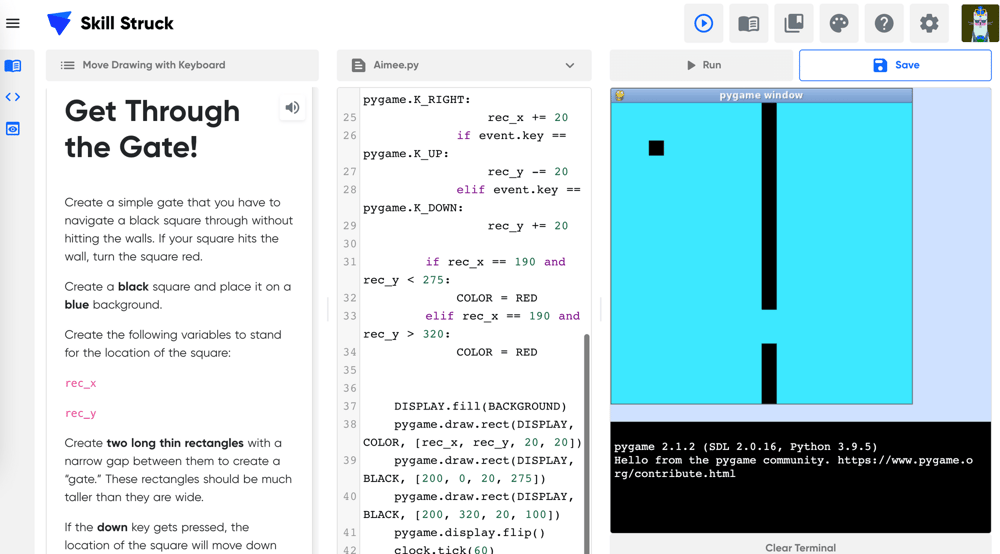
Get Through the Gate -
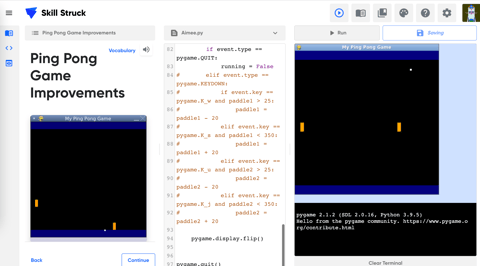
Ping Pong -
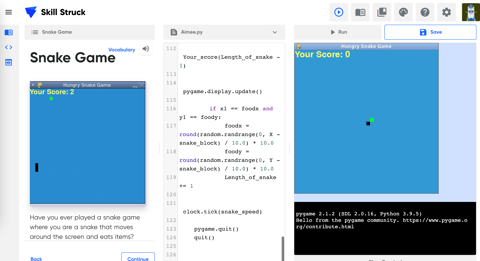
Snake -
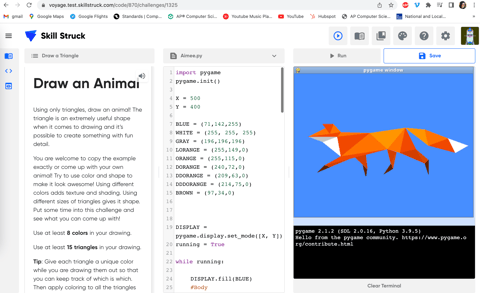
Draw an Animal -
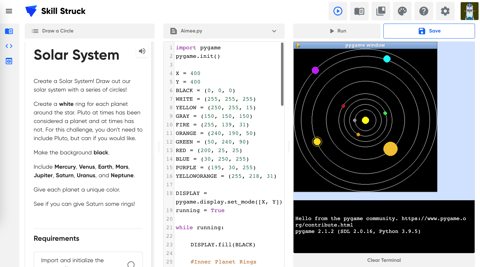
Solar System


