FREE K-12 AI LITERACY COURSES FOR THE 26-27 SY! Learn more here.

PCEP Certification Prep
This course dives deep into Python concepts in order to prepare for the PCEP Certification.
- Python
- Certification Prep
- Voyage
- Year
- 9th grade
- 10th grade
- 11th grade
- 12th grade
Course Summary
This course dives deep into a wide variety of Python concepts, assuring a solid understanding of the Python language. Students learn different numeric systems such as binary, octal, and hexadecimal. They practice error handling and bitwise operators. They practice using Python functions in loops, dictionaries, and nested loops. They also practice recursive functions.
Course Outline
-
- About the PCEP Certification
- Introduction Welcome to Python! This lesson gives a great introduction to Python programming and will get you up and coding in no time.
- Variables Variables are an important part of programming. Let's find out how we can use them in this lesson.
- Input/Output Writing programs that can get input from the user is a valuable skill.
- Syntax & Comments This lesson covers basic Python syntax and how to add comments to your code.
- Variable Types There are lots of different ways that you can store data in Python. This lesson covers a few of those data types.
- Numbers This lesson covers different types of numbers that you can use in Python.
- Converting This lesson covers how to convert one data type into another.
- Python Concatenation Connecting strings together can be very useful. Let's take a look at how this can be accomplished.
- Python Math Math is an important part of programming. This lesson covers how we can use math in Python.
- Modulus This lesson covers using modulus in Python. We will take a look at its usefulness including how to tell if a number is even or odd.
- Strings Strings in programming are a lot different than strings in real life. Let's see how useful strings are in Python.
- String Methods Python provides methods or actions that we can take on our strings. This lesson will teach us some of the basic methods we can use.
- String Methods Continued This lesson continues the topic of methods that we can use with strings.
- Checking Strings Searching strings for certain characters, words or phrases is easy in Python!
- Concatenating Numbers Similar to how we concatenated strings, we can also concatenate numbers to strings and vice versa.
- Concatenating Numbers Continued This lesson covers formatting multiple integers and formatting by index.
- Lists Lists are one of the main ways that we organize data in most programming languages. This lesson covers how to use lists in Python.
- Python If Statements If statements allow you to decide what code should run depending on some conditions. This lesson will cover the basics on using if statements in Python.
- Python Conditionals This lesson covers conditionals and how you can use them to compare data. We will also use if statements to execute code based on the conditionals.
- Python Else If Statements Else If statements in Python allow you to add multiple if statements at once. The possibilities are endless!
- Python For Loops This lesson covers For Loops and how to use them in Python. You will also learn how to access each item in a list using a For Loop.
- Printing Specifics in Python
-
- If Statement in a For Loop Why not combine a few of the previous lesson content? Let's take a look at using if statements in for loops.
- Python Accessing Items in a List Lists are great but not very useful if we can't access the items inside of them. Let's take a look at how to access these items without needing to use a for loop.
- Using Integers from a List Learn about different ways to use a list of integers!
- Adding to Lists in Python Learn different ways to add to and remove from a list in Python.
- Removing from Lists in Python Learn different ways to remove items from lists in Python
- Python Lists Continued This lesson continues on the topic of lists and accessing items inside of them.
- Python While Loops While loops are looping code structures that run WHILE something is true.
- Python Functions Functions are a great way to break up long sections of code and can be used multiple times without having to rewrite them.
- Python Function Parameters One of the great things about functions is that we can pass parameters to them and the function can handle the rest.
- Multiple Parameters in Python Functions Two is better than one! Let's learn how we can pass multiple parameters to a function in Python.
- Python Dictionaries The second grouping of information we will look at in Python is dictionaries. Don't get these confused with real world dictionaries!
- Adding to and Removing from Dictionaries Learn the different ways to add to or remove from a dictionary in Python.
- Dictionaries Continued Let's continue learning about dictionaries in Python, specifically how to add and remove items, check the dictionary's length, and look for certain keys in a dictionary.
- Looping Through a Dictionary Using For Loops with dictionaries is easy! Let's see how this is accomplished in Python.
- Looping Through a Dictionary Continued This lesson adds to our knowledge of dictionaries and for loops.
- Tuples This lesson introduces tuples and how we can use them to store data in Python.
-
- Reading Files One of the most useful features of Python is the ability to create, read, write, and edit files. This lesson covers the basics of this functionality.
- Reading Parts of a File This lesson will cover how to read only specific parts of a txt file.
- Append a Line to a Text File This lesson will teach you how to write a program that can edit text files.
- File Write Mode This lesson covers how to use the "w" command in the open() function.
- Multi-dimensional Lists This lesson covers multi-dimensional lists, and how they can be used in programming.
- Iterating through 2D Lists This lesson will cover how to use for loops to iterate through each element of a 2D list.
- Nested For Loops This lesson covers the use of nested for loops when working with 2D lists.
- Object-Oriented Programming This lesson covers the basics of object-oriented programming.
- Creating an Instance/Object This lesson covers how to create an instance of your class.
- Objects Continued
- Super Classes
- Python Random Learn how to get random values in Python
- Recursion This lesson will cover recursion, which is the technique of using functions that call themselves.
- Recursion vs Iteration This lesson covers the difference between recursive algorithms and iterative algorithms.
- Bubble Sort This lesson teaches about the Bubble sort algorithm, and how it is implemented.
- Selection Sort This lesson covers Selection Sort, another sorting algorithm.
- Insertion Sort This lesson covers Insertion Sort, a useful data sorting algorithm.
- Merge Sort This lesson covers Merge sort, a useful data sorting algorithm.
- Python API
-
- Python 1 Project #1: Reading Competition This is the first Python Project. You got this!
- Python 1 Project #2: Simple Calculator This is the second Python Project. Keep it up!
- Python 1 Project #3: Story Maker This is the third Python Project. Good luck!
- Python 1 Project #4: Team Roster This is the fourth Python Project. You got this!
- Python 1 Project #5 Decipher Fifth python project, good luck!!
- Python 1 Project #6 Mad Libs! Make your computer talk! For this lesson we are going to use inputs and print statements to make your computer talk. Start by creating a Mad Libs, you can use the one above, or you can find one on the internet. You will store the nouns, places, and adjectives in variables and then print them.
- Python 1 Project #7: Earnings Calculator This is the ninth Python Project. Great job!
- Python 1 Project #8: Sentence Generator This is the third Python Project. You're doing great!
- Python 2 Project: Nicco's Pizza You are the new owner of Nicco’s Pizza in Rome Italy and Gordon Ramsey, The Cake Boss, and many other food celebrities are coming to eat at your restaurant. Since it is the very best Pizza it needs to have the very best ordering system.
- Python 2 Project: Leap Year leap year calc
- Python 2 Project: Prime Number Calculator Prime number calc
- Python 2 Project: Guess the Word Hangman
- Python 2 Project: Contact List Contact list
- Python 3 Project: Factorials In this project, students will write a program that receives one number as the input, then calculates the sum of all factorials of its factorial.
- Team Project and the Software Development Life Cycle
- Project: Odd One Out
- Project: Partners for a Project
-
- History of Computer Science Timeline Learn about the history of computer science and see how far we have come!
- Computer Parts and Pieces Learn how different components work together to help a computer run.
- From Electricity to a Bit Learn how information moves through computer components to generate the programs you enjoy.
- Programming Languages
- Digital Citizenship Learn about digital citizenship and how you can be responsible with your technology.
- Intro to the Internet Learn what a network is and what parts of our lives interact with networks.
- Network Topologies Learn how different layouts of networks can help information move more efficiently
- Addressing Learn how addressing works in the internet.
- Types of Threat Learn about the different approaches criminals might take cause problems.
- Cyber Bullying
- AI, Machine Learning, & Automation Learn how artificial intelligence, machine learning, and automation are affecting your world and potential changes in the future.
- Accessibility Learn about how we can make computer programs more accessible.
- The Digital Divide
- Troubleshooting Learn some strategies for fixing computer problems.
- Error Messages & Debugging
- Data Structures Learn about the different ways we use data and the challenges associated with data collection, structure, and interpretation.
- Binary Learn the basics of binary--why it exists and how the computer uses it to communicate information.
- Representing Numbers with Binary Learn how to convert information into binary and back.
- Bits and Bytes Learn what bits are and how they relate to binary!
- Bigger Bytes Learn about the different sizes of data.
- Encryption Learn how encryption helps make things more secure.
- Data Learn how computers help us understand data sets.
- Personal Data Learn how your personal data is available and could be without you knowing it!
- Copyright Learn about the different laws surrounding creative works.
- Simulations Learn how to use random to create simulations.
- Resume Building Intro to Resume Building!
- Legal and Ethical Concerns in Innovations Learn about legal and ethical concerns surrounding computing innovations.
- Passwords Learn how to make a strong password.
- Computer Innovations Explore how different computer innovations have affected our everyday lives.
- Logical Thinking Explore how different statements compare logically.
- Octal Number System
- Hexadecimal Number System
- Bitwise Operators
- Error Handling
-
- Software Development Methods
- Sequential and Parallel Computing Learn how sequential and parallel computing work and when each might be used.
- Evaluating Algorithms
- Testing an Algorithm for Efficiency Learn some techniques that can test different different algorithms to see how efficient they are.
- Data Structures Learn about the different ways we use data and the challenges associated with data collection, structure, and interpretation.
- Bandwidth and Scalability Learn what bandwidth is and how it affects your internet use. Learn what elements make the internet scalable and what hinders scalability.
- Cybersecurity Posture Learn about different ways you can stay safe while using the internet.
- Number Limitations, Overflow, and Roundoff Learn about limitations for binary
- Packets and Protocols Learn how packets and protocols help the internet function smoothly.
- Redundancy and Internet Stability Learn about different strategies we use to stabilize the internet.
- Network Parts and Pieces Learn about the different parts that help make the internet run!
- Visualizing Algorithms Learn how to create flow charts to visualize your algorithms.
- Printing Specifics in Python
- Python Math Library
- Python Datetime
- Python API
- Memory and Storage
Standard Alignment
CSTA K-12 Computer Science Standards
- 2-AP-10
- 2-AP-11
- 2-AP-12
- 2-AP-13
- 2-AP-15
- 2-AP-16
- 2-AP-17
- 2-AP-18
- 2-AP-19
- 2-CS-01
- 2-CS-02
- 2-CS-03
- 2-DA-07
- 2-DA-08
- 2-IC-20
- 2-IC-21
- 2-IC-22
- 2-IC-23
- 2-NI-04
- 2-NI-05
- 2-NI-06
- 3A-AP-13
- 3A-AP-14
- 3A-AP-15
- 3A-AP-16
- 3A-AP-17
- 3A-AP-18
- 3A-AP-19
- 3A-AP-21
- 3A-AP-22
- 3A-AP-23
- 3A-CS-01
- 3A-CS-02
- 3A-CS-03
- 3A-DA-10
- 3A-DA-11
- 3A-DA-12
- 3A-IC-24
- 3A-IC-25
- 3A-IC-27
- 3A-IC-29
- 3A-IC-30
- 3A-NI-04
- 3A-NI-05
- 3A-NI-06
- 3A-NI-07
- 3A-NI-08
- 3B-AP-08
- 3B-AP-09
- 3B-AP-10
- 3B-AP-11
- 3B-AP-12
- 3B-AP-13
- 3B-AP-14
- 3B-AP-15
- 3B-AP-16
- 3B-AP-17
- 3B-AP-18
- 3B-AP-19
- 3B-AP-20
- 3B-AP-21
- 3B-AP-22
- 3B-AP-23
- 3B-AP-24
- 3B-CS-01
- 3B-CS-02
- 3B-DA-05
- 3B-DA-06
- 3B-DA-07
- 3B-IC-25
- 3B-IC-26
- 3B-IC-27
- 3B-NI-03
- 3B-NI-04
- Aligned to 16 Utah standards
State standards documents
| Document | Standards | Grades |
|---|---|---|
| National | ||
| 2022 Skill Struck Standards Alignment + Correlation Guide | CSTA K-12 Computer Science Standards · 2022 | K-2, 3-5, 6-8, 9-12 |
| Alabama | ||
| Alabama Course of Study Digital Literacy and CS Standards + Skill Struck Alignment | Alabama Course of Study Digital Literacy and CS Standards | K-2, 3-5, 6-8, 9-12 |
| Arizona | ||
| Arizona Computer Science Standards + Skill Struck Alignment | Arizona Computer Science Standards | K-2, 3-5, 6-8, 9-12 |
| Arkansas | ||
| Arkansas Computer Science and Computing Standards High School Programming + Skill Struck Alignment | Arkansas Computer Science and Computing Standards High School Programming · 2023 | 9-12 |
| California | ||
| California K-12 CS Standards + Skill Struck Alignment | California K-12 CS Standards | K-2, 3-5, 6-8, 9-12 |
| Idaho | ||
| Idaho Content Standards Computer Science + Skill Struck Alignment | Idaho Content Standards Computer Science · 2023 | K-2, 3-5, 6-8, 9-12 |
| Illinois | ||
| Illinois Computer Science Standards + Skill Struck Alignment | Illinois Computer Science Standards · 2022 | K-2, 3-5, 6-8, 9-12 |
| Indiana | ||
| Indiana K-12 Computer Science Standards + Skill Struck Alignment | Indiana K-12 Computer Science Standards · 2023 | K-2, 3-5, 6-8, 9-12 |
| Iowa | ||
| Iowa Computer Science Standards + Skill Struck Alignment | Iowa Computer Science Standards | K-2, 3-5, 6-8, 9-12 |
| Kansas | ||
| Kansas CS Standards P-12 + Skill Struck Alignment | Kansas CS Standards P-12 · 2023 | K-2, 3-5, 6-8, 9-12 |
| Kentucky | ||
| Kentucky Academic Standards for Computer Science + Skill Struck Alignment | Kentucky Academic Standards for Computer Science · 2023 | K-2, 3-5, 6-8, 9-12 |
| Maryland | ||
| Maryland K-12 CS Standards + Skill Struck Alignment | Maryland K-12 CS Standards · 2023 | K-2, 3-5, 6-8, 9-12 |
| Massachusetts | ||
| Massachusetts Digital Literacy and Computer Science Standards + Skill Struck Alignment | Massachusetts Digital Literacy and Computer Science Standards · 2023 | K-2, 3-5, 6-8, 9-12 |
| Michigan | ||
| Michigan K-12 Standards Computer Science + Skill Struck Alignment | Michigan K-12 Standards Computer Science · 2023 | K-2, 3-5, 6-8, 9-12 |
| Mississippi | ||
| Mississippi College and Career Readiness standards for Computer Science + Skill Struck Alignment | Mississippi College and Career Readiness standards for Computer Science · 2022 | K-2, 3-5, 6-8, 9-12 |
| Missouri | ||
| Missouri K-12 Computer Science Performance Standards + Skill Struck Alignment | Missouri K-12 Computer Science Performance Standards · 2023 | K-2, 3-5, 6-8, 9-12 |
| Nebraska | ||
| Nebraska K-12 Technology Standards + Skill Struck Alignment | Nebraska K-12 Technology Standards · 2023 | K-2, 3-5, 6-8, 9-12 |
| Nevada | ||
| Nevada Academic Content Standards for CS + Skill Struck Alignment | Nevada Academic Content Standards for CS | K-2, 3-5, 6-8, 9-12 |
| Nevada Academic Content Standards for Integrated Technology + Skill Struck Alignment | Nevada Academic Content Standards for Integrated Technology | K-2, 3-5, 6-8, 9-12 |
| Nevada Computer Science Standards + Skill Struck Alignment | Nevada Computer Science Standards | 9-12 |
| New Jersey | ||
| New Jersey Computer Science and Design Thinking Standards + Skill Struck Alignment | New Jersey Computer Science and Design Thinking Standards · 2020 | K-2, 3-5, 6-8, 9-12 |
| New York | ||
| New York Computer Science and Digital Fluency Learning Standards K-12 + Skill Struck Alignment | New York Computer Science and Digital Fluency Learning Standards K-12 | K-2, 3-5, 6-8, 9-12 |
| North Carolina | ||
| North Carolina K-12 CS Standards + Skill Struck Alignment | North Carolina K-12 CS Standards | K-2, 3-5, 6-8, 9-12 |
| Ohio | ||
| Ohio's Learning Standards Computer Science + Skill Struck Alignment | Ohio's Learning Standards Computer Science · 2023 | K-2, 3-5, 6-8, 9-12 |
| Oklahoma | ||
| Oklahoma Academic Standards for Computer Science + Skill Struck Alignment | Oklahoma Academic Standards for Computer Science | K-2, 3-5, 6-8, 9-12 |
| Rhode Island | ||
| Rhode Island's K-12 CS Education Standards + Skill Struck Alignment | Rhode Island's K-12 CS Education Standards | K-2, 3-5, 6-8, 9-12 |
| South Carolina | ||
| South Carolina's Computer Science Standards for High School + Skill Struck Alignment | South Carolina's Computer Science Standards for High School · 2023 | 9-12 |
| Tennessee | ||
| Tennessee K-12 Computer Science State Standards + Skill Struck Alignment | Tennessee K-12 Computer Science State Standards · 2023 | K-2, 3-5, 6-8, 9-12 |
| Texas | ||
| TEKs Skills for CTE + Skill Struck Alignment | TEKs Skills for CTE | 9-12 |
| Utah | ||
| Utah 6-12 CS Standards + Skill Struck Alignment | Utah 6-12 CS Standards · 2019 | 6-8, 9-12 |
| Virginia | ||
| Virginia K-12 CS Standards + Skill Struck Alignment | Virginia K-12 CS Standards · 2023 | K-2, 3-5, 6-8, 9-12 |
| Washington | ||
| Washington K-12 CS State Learning Standards + Skill Struck Alignment | Washington K-12 CS State Learning Standards | K-2, 3-5, 6-8, 9-12 |
| Wisconsin | ||
| Wisconsin Standards for Computer Science + Skill Struck Alignment | Wisconsin Standards for Computer Science · 2023 | K-2, 3-5, 6-8, 9-12 |
Course Project
In this course students will complete challenges that help solidify concepts as they use skills in a variety of ways. In order to complete tasks, students will creatively apply what they've learned by using different approaches to reach a goal. This experience closely follows challenges they would face in a technical interview, allowing them to practice. Some examples of projects: Find the Even Numbers, Pirate Ship, Student Body President, Area of a Circle, Permission Slips
-
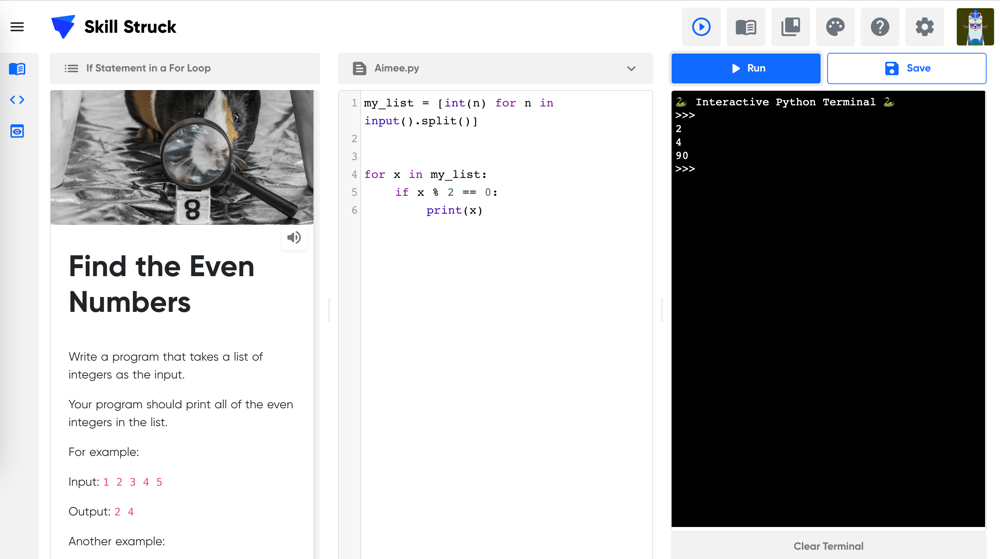
Find the Even Numbers -
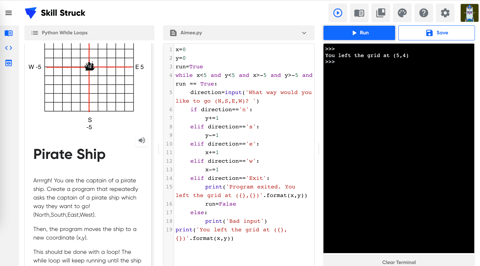
Pirate Ship -
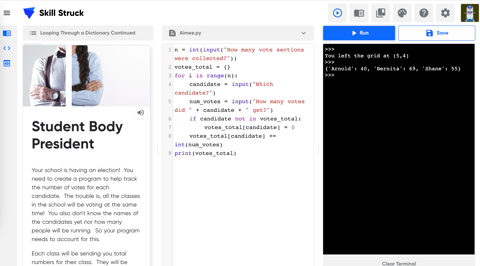
Student Body President -
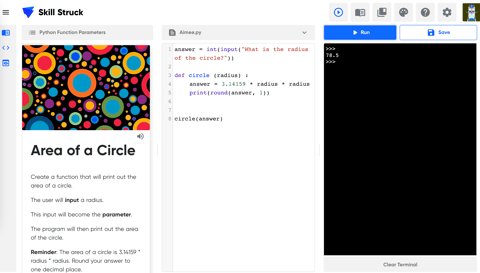
Area of a Circle


